


Long ago, the Troutbitten crew had a private forum where we exchanged ideas and stories every day. At the heart of those stories were the fishing reports. We fished hard, and we fished often. Those reports contained the details. Most times, it was nothing but the conditions, the tactics, the flies and an account of our success or failure. But what did we learn? That was always the question. Fishing Reports is now a series at Troutbitten . . .
The Setup
December 7, 2025
(For more info about tactics and decisions, follow the highlighted text links in the paragraphs below.)
In recent weeks, my short trips have been more successful than my longer ones, meaning I’ve had a better catch rate and found more trout. That’s probably because I’ve gotten into a better rhythm and stayed in it. With just an hour or two to spend on the water, I usually limit myself to one or two tactics, so no messing around with full leader changes. I still swap out different flies, but I leave the wholesale shifts for longer days on the water. And I think that commitment has kept me in the game and more focused, which has been especially important in the tough conditions of low, cold, clear water.

The Fishing
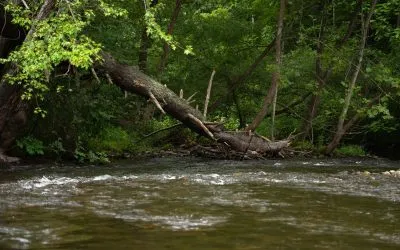
I started with streamers, just because I wanted to. Standard Mono Rig, relatively close at 30 feet, targeting bank water and the in-stream structure of rocks and logs. Low water allowed many of the troughs and potholes to stand out, so I treated those as structure as well. After about a hundred yards and a half hour, I gave up on the streamers, with not a single look from a trout.
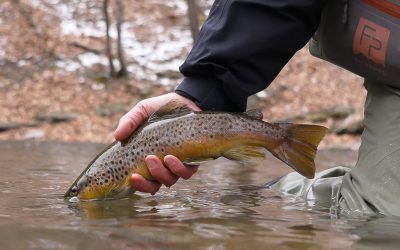
I swapped the 4X and the Half Pint over to 6x and a pair of fur nymphs. I alternated between a single #4 or #1 split shot about six inches above the point fly. I’ve turned to simple, small, unweighted nymphs frequently this fall and early winter, and it worked again. I immediately caught a trout in the next pothole.
Tightlining the skinny stuff produced more action than deeper slots. I turned just two trout in water of more than two feet deep — not what you might expect in water at 39 degrees Fahrenheit.

The spawn is mostly finished, but there were males to be seen guarding the redds. I still gave them space, because I don’t fish for trout near the redds. But I noted the locations, got a good look at the gravel, and I’ll be careful not to walk through these sections from now through March, when the eggs finally hatch.
Right now, I do believe the trout’s preference for thinner water is connected to the spawning process, at least in this river.
Every trout that I caught or missed ate the lower positioned nymph, so I clipped the top fly, just to simplify things. And I changed my target water focus away from the deeper stuff.
I felt that I needed to stay back a few extra feet in the lower conditions and thinner water, so I floated the sighter in some spots. The drifts were fine, but I wasn’t quite satisfied. Instead, I chose a small yarn indy, mounted on a piece of 4X, just below the sighter. That allowed me to truly suspend the flies. I now had the distance that I wanted, and I had tight line principles taken further than a natural tight line range, with the use of the indy.
But the wind caught the yarn too often . . .
I could have benefited from a regular Standard Mono Rig, The butt section in my hands was #18 lb, rather than 20# lb, and the difference in power was noticeable. But adding a #6 split shot just above the yarn, helped overcome the wind, and I was back to comfortable casting. Adding the shot there is an odd solution, but one that I’ve used for many seasons. It’s a problem solver and for me a better choice than attaching a bobber style indy.

Tb Yarn Indy Hack
The next hour and a half was fun. Trout ate a very small Sucker Spawn and a Walt’s Worm about equally as well, as I switched every 15 minutes or so. That, along with sliding the indy up or down to accommodate for depth, were the only changes I made.
After all these years, I’m still stunned by how many trout cannot be seen in low, clear conditions. Sometimes I even saw the small yellow fly but couldn’t see the trout until the yellow disappeared. Fish on.
With quitting time approaching, I spent the last ten minutes back on a Half Pint. I caught one trout with a Slow Slide.
Good times. It’s getting cold out there.


Stats and Thoughts
Time: 200 mins
Caught: 13
Lost/Missed: 5
Flies Eaten: #16 Sucker Spawn (yellow). #20 UW Sexy Walts, #18 UW Cress Bug, Half Pint (mini version, jig hook 3.5 bead)
Leaders: Standard Mono Rig (18 lb variant)
Terminal Tippets: 6X
Weather: Clouds. 25 degrees and breezy. Pressure 30.01 and stable.
Water: Super low, super clear

Comments
If I had more time, I would have liked to see if the streamer would produce more at the end. The Standard Mono Rig is really perfect for the indy approach, and it’s arguably the best way to gain distance. I had good control over placement of fly then indy, in the same lane, and on the longest casts, the Standard mended easily to keep tension off the indy. I’ve been fishing a Crossover Thin a lot lately, but today I was reminded how helpful the power of the thicker butt section is in so many situations. I only wished for the Crossover again while fishing the streamer. As time goes on, I’m liking a Thin leader for streamer work.
Fish hard, friends.
** Donate ** If you enjoy this article, please consider a donation. Your support is what keeps this Troutbitten project funded. Scroll below to find the Donate Button. And thank you.
** Subscribe to Troutbitten and follow along. (It’s free.) **
Enjoy the day.
Domenick Swentosky
T R O U T B I T T E N
domenick@troutbitten.com






Dom,
Of all your great advice I’ve implemented over the years the split shot at the Dorsey helped me the most. On some tailwaters I fish the type of indicator makes a huge difference and the wind would shut me down. I first read your split shot at Indy tip a few years ago and immediately had a solution to what I thought was an unsolvable problem that negatively impacted my catch rate. It’s good to see it reiterated here.
Scott Miller
Nice
You parked those flies out there! I enjoyed reading this.
That’s right!
Hey Dom, love this outing report! I can picture the changes in tactics. Whoa, you miss fish too? That’s fishing. I’ll have to try the weight with the yarn next time it’s breezy.
Oh, buddy. Everyone misses trout. I think plenty of trout refuse a nymph at the last moment, just like we see them reject a streamer or dry. So they might bump the nymph, but never eat it. In that case, we never had a chance to hook the fish. We tend to think of misses as our fault, but I don’t think that’s always the case.
Cheers.
Dom
Love this new feature, Dom. What a treasure trove of info and resources you continue to compile. Thanks for everything you do!
Cheers. Thanks very much. Glad you like it.
Great article! Thank you for the write up. Would you mind answering what you used to take the pictures in this article?
Thanks,
John
Sony a6700. My camera gear choices are always centered around portability. I’m fishing, first. Filming second. Cheers.
Good stuff Dom,
I liked all the details in here: (i.e.) seeing how much time/distance you dedicated to a streamer before switching, clipping off the top nymph, what streamer retrieve worked etc….These are the details that make us all love Troutbitten. Thanks for all the content!
Cheers
Good stuff, I like it.
Fishing streams a few hours from you this is good interesting information and can use it.
Tom
Hello Dom great article very enjoyable.
MayI ask a quick question about using / modifying the standard mono rig. On one of my favourite rivers leader length is limited by regulation to max length of 19ft6” including tippet.
To maintain power in the leader and accommodate the length limit rule how would you suggest modifying the standard rig
All the best for the “holidays”
Please give us one of these reports for a nights shift.