


Long ago, the Troutbitten crew had a private forum where we exchanged ideas and stories every day. At the heart of those stories were the fishing reports. We fished hard, and we fished often. Those reports contained the details. Most times, it was nothing but the conditions, the tactics, the flies and an account of our success or failure. But what did we learn? That was always the question. Fishing Reports is now a series at Troutbitten . . .
The Setup
(For more info about tactics and decisions, follow the highlighted text links in the paragraphs below.)
(December 31, 2025)
This December was different. The fishing was difficult, and the trout were outside of their expected habits for the time of year. But for any angler who fishes year round, and for a fisherman who’s done it for decades, observing patterns and changes is an enjoyable aspect of the process. The daily, seasonal and yearly changes are interesting. This is what keeps us coming back.
I have no doubt that the cause for these December differences was the low water. Our river flows were in the fifth percentile — meaning for all the years that records have been kept, there’s been more water in these rivers ninety-five percent of the time. (Not necessarily historically low, but damn close.)
Early in the month I started noticing thinner trout on average. Nothing extreme, but notable. The tail end of the spawning season was also different. And sometime in the first or second week of the month the switch turned off. Somebody pulled the lever. The spawning process was finished. Normally, I see spawning activity taper off over ten days or so. This year, it started late then finished early, with abrupt bookends.
Trout also seemed to move into deeper water sooner, especially when the cold front hit about a week before Christmas. With such low, clear flows, no wonder trout seemed eager to move out of shallow spawning grounds and into the relative safety of deeper and darker areas in the river.
But the last week of the year brought some weather events that added flow to these thirsty rivers. And on the final day of 2025, I fished one of my favorites . . .


The Fishing
I stepped into the river with a satisfied sigh.
For some perspective, the CFS was now triple that of when I’d last fished it, earlier in December, yet it was still under the seasonal average.
I started with streamers because I hadn’t walked far from the truck. And on cold days, I like to build up some body heat to begin the trip. I use streamer fishing like this in the winter. It’s a way to keep moving, to stay warm. And it’s a great way to cover slower sections of water that I might not have the patience for otherwise.
For me, the winter game here is nymphs and streamers, in rhythm, covering water with the long flies and then slowing down into the buckets and deep holes to dead drift nymphs.
Our long winter season is a yearly reminder that without a good underwater game, no one is catching fish. Midge hatches here are sparse, unreliable, and they tend to produce tiny trout at the surface. I’m ready for the rises, but I can go weeks without running into a decent midging opportunity. So from my perspective, the dry-flies-only mindset of some anglers seems silly. And I truly enjoy the challenge of delivering flies that are convincing enough to fool a trout, up top or underneath.
I caught two and moved three more decent fish in the first hundred yards of river. I worked upstream, because presentation options are far more varied when the fly begins up and across — with the currents (to start) rather than against them. I was surprised when trout made multiple efforts toward the Half Pint streamer. Most often, these wild browns take one look and it’s over. So I was startled to see trout flash, follow, swipe and finally eat.

Half Pint Eater
At the head of the first flat, I swapped out my tippet section for nymphs, assuming that the faster water would hold trout in the slower seams and stalled swirls of pockets. That theory was only partly true.
I fished a Micro Mono Rig for the whole trip. That wasn’t my plan going in, but the leader was attached from my previous outing, and action was solid enough to stick with it. On colder days, I change less. I tie fewer knots. I experiment less. I love the simplicity of this season. Trout will eat egg patterns and a handful of my favorite nymphs, along with streamers, on a good day. And I have such confidence in the flies that I focus intently on the presentations.
When I caught just a couple trout at the head of the flat, I went back to streamers, trying to duplicate my success, yet the next fifteen minutes produced nothing.
I don’t really enjoy fishing streamers on such a thin leader. But there’s no doubt that holding line off the water at some pretty extreme lengths is fun. However, it’s also not necessary, and it can pull me into some bad habits, if I’m not careful.
I continued with the Half Pint into the next tailout and worked my way to the middle of that section, right where the ripple from the minor run above settled into the flat. These kinds of areas are my A water in the winter. So I wasn’t surprised when I caught another trout that ambushed the Half Pint from a submerged rock.
Going back to nymphs was a good idea. I covered the same fish that had seen my streamer, and I found multiple fish willing to eat the sucker spawn presented very low.
The nymphing setup was a bait and switch rig. With a small egg pattern trailed by a simple fur nymph. Production was evenly split between the two.

For about a forty-five minutes, I fished small beadhead nymphs on the Micro Mono Rig with 7x tippet, testing #18’s and #20’s in tandem and a #16 solo. These small light flies are what I normally fish with a Micro Mono Rig, and it’s mostly what I call a Tracking approach — essentially, a long drop with very little leading or influence from my end. But I never caught a trout that way. Instead, every hit on a nymph came when the flies were low in the column, in the strike zone and established into the drift. So even on the Micro Rig, I went back to the egg and fur combo, unweighted and fished with about 30-50 centigrams of split shot. I got the flies down quicker and then led them through the drift slowly — just fast enough to keep them from hanging up. This is standard winter stuff for me, and the same nymphing approach works well throughout the year.
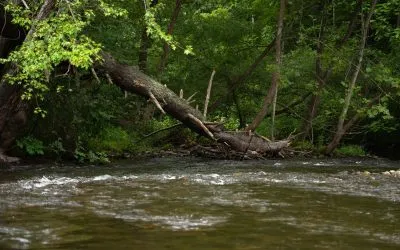
Nymphs and streamers, dead drifts and animation. I settled into a rhythm and covered water, without thinking too much, just enjoying the best winter fishing day of the year. And by that, I mean that things seemed normal for a change. The weather was cold and windy, creating ice at the edges of the river. The water had its characteristic limestone-green in the deeper parts. And the fish responded well enough to keep things interesting. It was good, hard winter fishing.


Stats and Thoughts
Time: 275 mins
Caught: 13
Lost/Missed: 6
Flies Eaten: #14 Sucker Spawn (yellow). #16 Olive Walt’s (no bead), Half Pint (mini version, jig hook 3.5 bead)
Leaders: Micro Mono Rig (5 lb butt section)
Terminal Tippets: 4X and 5X for the nymphs. 4X for the streamers
Weather: Clouds. 24 degrees with wind. Pressure 29.97 and stable
Water: Good flows. Good color.
Trout did not respond to any streamer near the banks — not even tight to downed logs and brush. If the water was thinner than calf deep, I had no hits. Maybe trout simply weren’t there, because all action came in deeper flows.
Nymphing action was similar. And it was the kind of day where finding the right water type was most important. Nothing happened at the head of the runs or in the tailouts, although I kept trying. Instead, trout responded in the middle seams where the water was deeper — knee to belt deep sections.
Good times, and a great way to finish out 2025.
Fish hard, friends.
** Donate ** If you enjoy this article, please consider a donation. Your support is what keeps this Troutbitten project funded. Scroll below to find the Donate Button. And thank you.
** Subscribe to Troutbitten and follow along. (It’s free.) **
Enjoy the day.
Domenick Swentosky
T R O U T B I T T E N
domenick@troutbitten.com





Good stuff, thanks
Cheers, buddy.
These fishing reports are great. Keep doing them!
Thanks, Marc. Glad you like the new series. Cheers.
Dom
Love this series. I do something very similar and keep it in the notes section in my iphone. Really helpful for so many reasons. Fun to read other peoples reports other than my own.
Cheers.
Love that these are back. This is what TB was mostly when I stumbled upon it. 🙂 Keep em comin.