

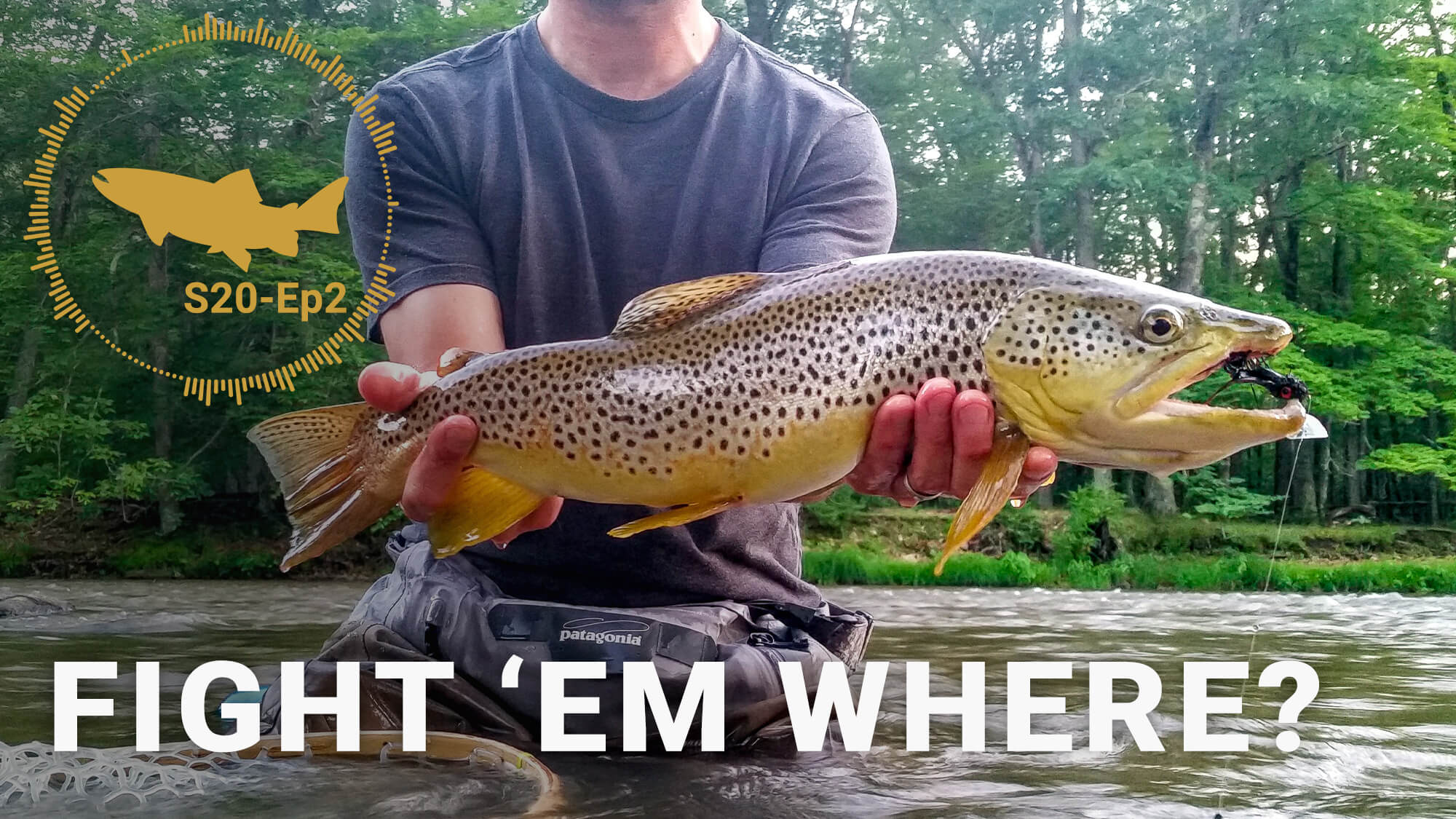
The Troutbitten Podcast is now available on YouTube as a video podcast, along with the audio podcast platforms.
** Note ** The YouTube video is embedded below, followed by the the podcast player and links to your favorite podcast platforms.
Fighting trout in a river, creek or stream is all about the currents. So for this episode of our seven part skills series on fighting big fish, we talk about fighting fish upstream, downstream or across. What are the advantages and disadvantages of each angle? And what about current depth? Should we aim to fight the fish in the lower, middle or top part of the water column? And finally, we talk about the fighting zones in a river, meaning, what types of water are a safe choice for fighting the biggest trout of your life?
We also go through a little more on the hooksets from last week, and we briefly discuss how much of this applies to the stillwater game and to other species.
Here’s the Episode List for Season 20
1. The Hookset and What Comes First
2. Where to Fight Them (Water Column and More)
3. Fight Them Fast (You Pull or They Pull – Work With a Trout)
4. The Fighting Position
5. Side Pressure
6. The Last Ten Feet (The Finishing Moves)
7. Wrap Up (With Stories)
My good friends, Matt Grobe and Bill Dell join me for this season.
Resources
CATEGORY: Troutbitten | Catch and Release Safely
CATEGORY | Troutbitten | Fighting Fish
PODCAST: Troutbitten | How to Handle a Trout
ARTICLE: Troutbitten | Are We Taking the Safety of Trout Too Far?
READ: Troutbitten | Work With a Trout and Not Against It
ARTICLE: Troutbitten | Fight Fish Fast
Here’s the video . . .
(Please select 4K or for best video quality)
If you enjoy this video, the best way to support the effort is to like the video, leave a comment and subscribe on YouTube.
Here’s the Audio Podcast . . .
Listen with the player above, or . . .
Find the Troutbitten podcast on any of these services:
— Apple Podcasts
— Spotify
— Google Podcasts
— Amazon Music
. . . and everywhere else where you listen to podcasts.
You can find the dedicated Troutbitten Podcast page at . . .
Season 20 continues next week. So look for that in your Troutbitten podcast feed.
Fish hard, friends.
** Donate ** If you enjoy this podcast, please consider a donation. Your support is what keeps this Troutbitten project funded. Scroll below to find the Donate Button. And thank you.
Enjoy the day.
Domenick Swentosky
T R O U T B I T T E N
domenick@troutbitten.com




An excellent conversation. A guide on the Missouri taught me many years ago about reeling slow while keeping constant pressure and letting the fish stay in is comfort zone lower in the water column. Amazing how many big fish can be brought in close, then the real fun starts when you decide it’s time to turn their head for the finale.
Right on.
You talked about being willing to move downstream so that you are either parallel to or below the fish. I’m not as young or agile as I used to be and do more trout fishing at night than during the day so moving downstream in the dark is potentially hazardous. Do you use the same approach at night, especially when a lot of the fish are being hooked directly across the stream or downstream of the casting position?
Thanks for addressing my comment on the podcast; I’ll definitely put the suggestions to work on my next outings on my home waters in CO and in WY. I guess I should have added that when I fish at night I go with the idea that I’m targeting big fish so I go with “goat rope” class tackle – nothing lighter than 12-lb tippet (and often 14 or 17), a 7-wt rod unless I’m on super skinny water, and, as I do when streamer fishing (pretty much 95% of my daytime trout fishing), I fight the fish hard and, assuming the hook (2s, 4s, 6s) have a good purchase, my biggest concern is getting the fish in a good position to be netted, or, if netting isn’t an option, brought to hand.
I did fight one fish a little too hard – very first big brown hooked at night got downstream and I had already waded to the “cooeee!” level of my waders – there was no going farther downstream without flooding. I was keeping to rod low and sideways and working the fish back to me and leaned on the rod just a smidgin too much – “snap!” My two-piece 9’9″ 7-wt became a 3 piece. I then handlined the fish in (even greater purchase on them that way, to be honest), took a couple of quick pictures, gathered the bits of graphite, and headed home.