Articles in the Category Dry Fly Fishing

Fishing With Visible Flies — Learning From What You Can See (VIDEO)

Seeing the fly is one of the most enjoyable aspects of fishing. But there’s a world of education inherent, too. Watch the fly dance and fall as it mixes with the currents. Notice how it responds to rod tip animation and line strips. Then see a trout materialize around the fly and judge its reaction. Visible flies are teachers. Whether dries, wets, nymphs or streamers, watching the fly helps us refine the techniques that catch fish.

Fish and Film – Dry or Die (VIDEO)

Every summer I fish dry flies more than anything else. This year, without really planning on it, that’s all I’ve fished. I haven’t touched a nymph or a streamer for about two months now. It’s been dry fly or die.

Summers are my off season from guiding, but life gets complicated. There’s all the branches of the Troutbitten Project to keep up with, and rest of life creeps in too. It all gets mixed together. It get’s too cluttered. And maybe simplifying my flies and tactics is a response to all that.

Can You Force-Feed Trout Big Dries? I Want to Believe

I’ve spent the better part of my summer testing a theory. Will the wild brown trout in my home waters eat a big dry fly? More specifically, will they eat it regularly? And for the trout that do fall for an extra-large fly, is their average size large to match?

Dry Flies In Fast Water – Fly Fishing Tips (with VIDEO)

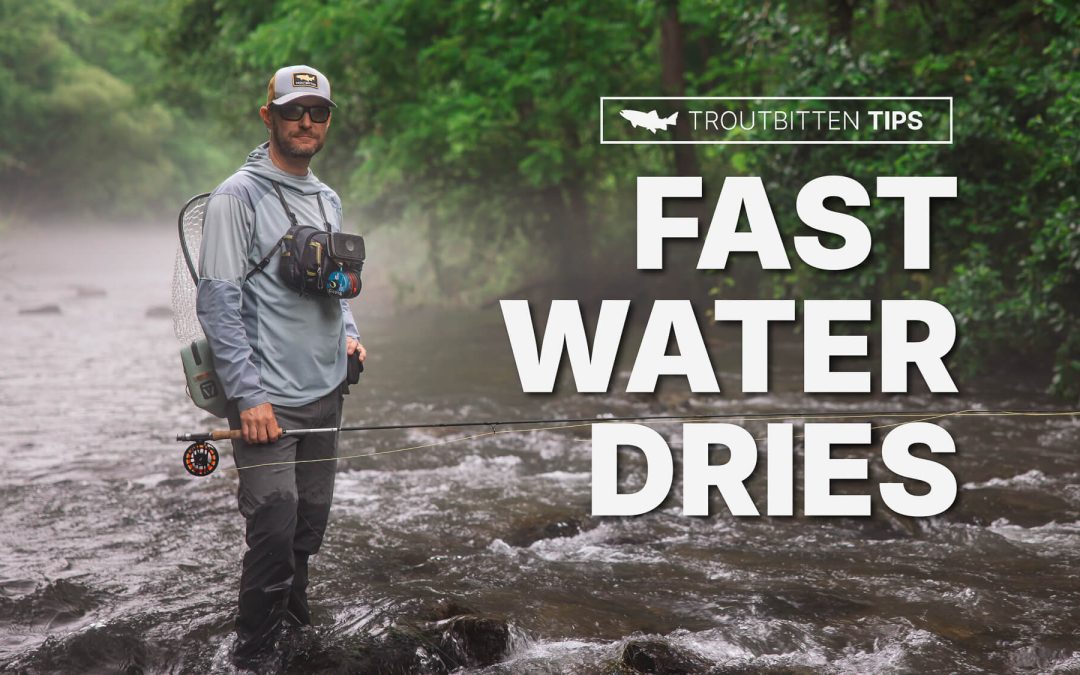
Here’s a look at fishing dry flies in faster water — in more complex currents — because there’s a unique set of skills to get true dead drifts in the fast water and pocket water. The drifts are shorter and harder to achieve. But some of the best fish hang out in faster stuff, and if you give them a great presentation you have a really good chance.

In this video, I cover three main skills that help meet the particulars of fishing dry flies in fast water. Those skills are also detailed below the video, in the article, with links to further Troutbitten resources.

Fish and Film – Dry or Die (VIDEO)

Fish and Film – Dry or Die (VIDEO)

Every summer I fish dry flies more than anything else. This year, without really planning on it, that’s all I’ve fished. I haven’t touched a nymph or a streamer for about two months now. It’s been dry fly or die.

Summers are my off season from guiding, but life gets complicated. There’s all the branches of the Troutbitten Project to keep up with, and rest of life creeps in too. It all gets mixed together. It get’s too cluttered. And maybe simplifying my flies and tactics is a response to all that.

Dry Flies In Fast Water – Fly Fishing Tips (with VIDEO)

Dry Flies In Fast Water – Fly Fishing Tips (with VIDEO)

Here’s a look at fishing dry flies in faster water — in more complex currents — because there’s a unique set of skills to get true dead drifts in the fast water and pocket water. The drifts are shorter and harder to achieve. But some of the best fish hang out in faster stuff, and if you give them a great presentation you have a really good chance.

In this video, I cover three main skills that help meet the particulars of fishing dry flies in fast water. Those skills are also detailed below the video, in the article, with links to further Troutbitten resources.

PODCAST: The Big Lie of Dry Dropper, S19 – Ep3 (VIDEO and AUDIO)

PODCAST: The Big Lie of Dry Dropper, S19 – Ep3 (VIDEO and AUDIO)

Dry dropper is great. Just put a nymph under that dry fly and get the best of both worlds. Right? Not so fast . . . The idea that you can have your cake and eat it too — that you’ll get perfect drifts on the dry fly and the nymph — and that you somehow double your chances by dropping a nymph under the dry is not true. This is the big lie of dry dropper fishing.

Here’s the problem: In most cases, neither fly ends up with a great drift. Instead, both flies are compromised and their natural drift is altered.

Where’s My Fly?

Where’s My Fly?

Understanding the fly’s position — where it is and where it’s going — is the key challenge in fly fishing. And aside from basic casting skills, an awareness of the fly in the current is the most essential skill.

Rain-X  As A Pre-Treatment

Rain-X As A Pre-Treatment

I apply Rain-X to all dry flies that leave my vise, if they don’t have CDC. I do the same with my yarn indicators. A simple drop of Rain-X dries completely in a few hours, leaving behind an unseen film of silicone that goes a long way to waterproofing materials for the river. I’m surprised more anglers don’t know about this. And no, Rain-X is not toxic after it dries.

read more
PODCAST: Dry Fly Platforms – The Outliers and The Wrap Up – The Troutbitten Fly Box (S18, Ep7)

PODCAST: Dry Fly Platforms – The Outliers and The Wrap Up – The Troutbitten Fly Box (S18, Ep7)

This Troutbitten Skills Series and these platforms are an effort to pass along the idea that fly selection doesn’t have to be regimented or complicated. Instead, see flies for what they have in common. Find their similarities rather than their differences. Choose the elements that matter most to you. Find the components of a fly that create enough of a distinction to be the keys to a platform, and build around that idea.

read more
PODCAST: Dry Fly Platforms – Hoppers, Stones and Foams- The Troutbitten Fly Box (S18, Ep6)

PODCAST: Dry Fly Platforms – Hoppers, Stones and Foams- The Troutbitten Fly Box (S18, Ep6)

It’s time for the big-meal dry fly platform: hoppers and stoneflies. With this platform, we substitute subtlety for buoyancy. Hackle is traded in for rubber legs, and dubbing is often replaced by closed-cell foam. In this episode, we break down this big-meal platform. We’ll look at a parts list, cover some pros and cons about material choices, and look at the particulars of the platform itself.

read more
PODCAST: Dry Fly Platforms – Emergers – The Troutbitten Fly Box (S18, Ep5)

PODCAST: Dry Fly Platforms – Emergers – The Troutbitten Fly Box (S18, Ep5)

A dry fly emerger is one that has part of the fly underneath the surface. It’s a highly effective form (meaning tout eat it) because it matches the most vulnerable state of things that trout see.

In this episode we cover the dry fly platform of emergers. We look at what they are, how and why to use them and the differences in styles within this platform. We cover some history about how emerger design got to this point and what the future might hold.

read more
PODCAST: Dry Fly Platforms – Down Wings – The Troutbitten Fly Box (S18, Ep4)

PODCAST: Dry Fly Platforms – Down Wings – The Troutbitten Fly Box (S18, Ep4)

The down wing dry fly style is a perfect match for one of the most ubiquitous insects found in trout rivers across the planet: caddis. The down wing platform is also a first choice for matching many terrestrials, like moths and hoppers, and it finds it’s way to stonefly patterns as well.

But for this discussion, we cover the down wing and its progression into fly boxes, by looking at three standouts: the Elk Hair Caddis, the X-Caddis and the CDC & Elk. Because the arrival of each of these patterns brought forth major innovations to the world of dry flies. All three of these are down wings, but they are very different players on the water.

read more
PODCAST: Dry Fly Platforms – Comparaduns – The Troutbitten Fly Box (S18, Ep3)

PODCAST: Dry Fly Platforms – Comparaduns – The Troutbitten Fly Box (S18, Ep3)

With its simple form of wing, body and tail, the Comparadun is another template for the dry fly angle — another perfectly adaptable platform.

When the Comparadun hit the scene in the 1970’s, it was a significant departure from the norm. Anglers recognized this, but more importantly, the trout recognized this. The Comparadun became a hatch matcher. It became the closer, because the Comparadun specialized in fooling selective trout, with perhaps the most realistic profile of a mayfly out there.

The unique design of the Comparadun caught on quickly, because, once again, it solved problems on the water. And it’s been fooling wise River trout ever since.

read more

Pin It on Pinterest