


About thirty years ago, I fished streamers on a Mono Rig for the first time. I’d read about long leader setups with no fly line in Joe Humphreys’ book, Trout Tactics. I was impressed with the control gained by having direct contact with the fly, but the truth is I didn’t have the knowledge or skills to make the most of what was possible.
Years later, after the addition of a sighter to the Mono Rig, with a more compact taper, and with just a level tippet under the water, what I now call the Standard Mono Rig was complete. I take no credit for the leader formula. I simply borrowed ideas from multiple sources and combined them to suit my needs and preferences — the same thing I did with guitar chords as a songwriter.
In the quarter-century since, I’ve experimented constantly with different leader designs. I enjoy testing the ideas of others and trying to improve on a system. I now have a handful of leaders that are built for specific situations, from dry flies to nymphs, wets and streamers. Although the Standard Mono Rig is far and away my best tool for underwater presentations, I continue to discover advantages with different formulas.
What I call the HV Thin Crossover is the latest leader build to find a permanent place in my kit. It solves a few problems and offers unique presentations: extra distance without sag, the option to hover a streamer around structure, and enhanced sensitivity.
Here’s the Formula
28 feet — 10 lb Maxima HV
42” — 8 lb Green Amnesia (Backing Barrel with tag attached here)
24” — 8 lb Red Amnesia
— Tippet Ring —
2X, 3X, 4X, 5X Fluorocarbon Tippet to suit

Mutation
A good fishing life is about evolution. And until recently, I didn’t have much need for a Mono Rig with these qualities. Honestly, I still do most of my fishing with the Standard, because I love its hybrid nature, both in the cast and throughout the drifts or retrieves.
But new ideas for ways to move a streamer created novel needs. And conversations with fishy friends about how they animate the streamer (or don’t move it much) had me faithfully working on some peculiar tweaks.
Longer Range | Limited Sag
I first saw the need for something more specialized when Bill Dell showed me his streamer, The Grinch. That strange fly came along with the concept of the Super Pause, and by spending long moments with a fly very near logs, banks and rocks, good things started to happen. Delly’s Grinch is purpose-built. It has a super-slow drop rate, but it’s heavy enough to carry a light line behind it, all the way to the target.

Delly’s Grinch
READ: Troutbitten | Streamer Presentations — The Super Pause
Ironically, the longer I fished the HV Thin Crossover, the more I realized how well it also suited flies with the fastest sink rates. George Daniel has entered the fly fisher’s collective consciousness with the jig streamer concept. I’ve fished heavy headed streamers on a tight line for many years, but from George and others, I’ve picked up on the simple downsizing of streamers (sometimes). Less material means less weight is required to achieve the same drop rate. That’s great. But with less weight and resistance, there’s less to counteract leader sag at long distance too. So I realized I needed to either fish closer or use a thinner leader.
When I’m nymphing, I don’t care much about long distance. I prefer targets of just two to three rod lengths away. I like to work close with a tight line, approaching trout from behind, with stealth and some practiced precision. If I do choose longer range targets with nymphs, I most often add a suspender to the rig — usually yarn, sometimes a dry, sometimes a small bobber.
But with streamers, I’ve always fished further away. I like having more room for animations — a longer chance to be creative and to sell the fly with every cast. I never much cared about the leader sag from a Mono Rig while fishing streamers, because I was either laying line on the water for a jerk strip retrieve, or with line in the air and tension to the fly, a little sag didn’t matter, because I was pulling the fly through the water anyway.
However, with more dedication to what I’ve long called a Crossover streamer presentation, I wanted to move the fly just a few inches with each rod twitch or hand strip.
READ: Troutbitten | Streamer Presentations — The Crossover Technique
PODCAST: Troutbitten | Streamer Presentations Skills Series #8 — The Crossover Technique S14, Ep8
I often describe the Crossover technique as trying to move the fly with minor animations inside a small space. Imagine the streamer hovering inside a globe the size of a basketball as it moves downstream. We might twitch and strip at different angles, directions and speeds throughout the presentation, but we never pull it out of that globe. The basketball moves with the fly. So if we strip the fly across seams into the next lane, the globe follows and resets around the streamer in its new position.
I’ve been working on the Crossover technique for half a decade or more. But in the last year, after the addition of the Super Pause and the slight downsizing of streamers, a different leader build has made all the difference.
Three consecutive days this past winter solidified things for me. The trout made the call. Their preferred water type was soft, against the bank, with some depth. The cast was a clean entry, with no extra line on the water and immediate contact. The fly was a 4 mm bead on a Craft Fur, a small Half Pint or an F2. And the presentation was a slow fall on a pendulum drop — just enough tension to keep contact, as the fly tracked toward the rod tip through the fall. Over and over, I felt a slight tap through the line as trout ate on the drop. If the fly made it to the bottom, I let the sighter pause, then I began Crossover motions — minor animations that mix together jigs, twitches, strips, head flips, speed leads and lane changes.

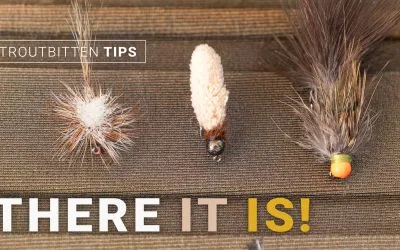
The F2 (Two Feathers)
The new leader was perfectly suited for all of this. And it opened up another set of presentation options.
Certainly, many leader builds can work in a similar way. I’ve tried materials and lengths in all manner of combinations. And here’s what works for me about the HV Thin Crossover.
More Power
Leader design is always a balance between power vs sag. Power matters in this case, mostly for accuracy. The truth is, the weight of the streamer will turn over any Mono Rig with a proper, speedy cast. With crisp stops flexing the fly rod, that kind of power generation can be sent through a stiff line with some substance. And when the streamer reaches the target, we have more control (accuracy) over the finishing stroke.
READ: Troutbitten | Fly Fishing Leader Design
Ten pound Maxima HV is a stiff material. That’s good. (Stretch it, and it lays flat.) Because the last thing I want in the butt section of any Mono Rig is limp monofilament. The lighter, longer and thinner I go with Mono Rigs, the more important it is to preserve whatever power is possible in the thinner line. There’s a remarkable difference in monofilaments. Almost all the opaque lines are very limp, therefore weak, with little power. Also, many lines have excess stretch, and that too robs the line of good casting power.
Extra Vis and Still Power
Amnesia continues to be one of the best choices for sighter material. It’s highly visible, yet not opaque. I often let the sighter touch the surface or dip underneath during streamer retrieves. And in those moments, surely a more subtle line puts off fewer fish than a solid color. (Granted, the difference is slight.)
My primary reason for choosing Amnesia is its stiffness. Once again, the relatively stiff material carries the power of the cast better than limp options.
Feel
These stiffer materials also transmit vibrations better than soft, limp lines. There’s no doubt about this, and it’s confirmed across the fishing landscape. With subtle animations, long drops and a Super Pause, the hits from trout tend not to be grabby or aggressive. So feeling the slightest take is a big advantage.
Less Sag
All of the aforementioned qualities matter. But the biggest difference is the thinner butt section. At .012”, it’s significantly lighter than my Standard Mono Rig. And for these distances, with these presentations, it matters. With the thinner butt section, I surrender some of the power of a tuck cast. But with these kinds of streamer presentations, I’m not overpowering the tuck to introduce slack. Instead, I most often want to land with contact. Instead, it’s a fly first entry, with immediate control. That’s how I hover the fly on a Super Pause, and that’s how I sense the takes in a pendulum drop.
With a heavier leader, like the Standard Mono Rig, my range for these kinds of streamer presentations is limited to about two-and-a-half to three times the rod length, depending on the weight of the fly or split shot.
So why not choose to go thinner? Why not fish a Micro Leader? Because with the flies I fish and the distance I choose, a thinner leader simply isn’t necessary. I also enjoy the power of the material that is still there in the cast. If I do want a bit more distance with lighter flies, It’s easy enough to extend the sighter section from the tippet ring. Adding two or three feet of six pound Amnesia or 3X sighter material gains five to seven more feet of sagless reach.
Overall, the HV Thin Crossover gives me the range I need with a wider set of weight.
Extra Duty
I’ve written here of streamers presentations. But I’ve been rotating this leader in with nymphs as well.
It’s very similar in performance to my Thin Mono Rig, with of course the difference of the HV butt section. I chose high vis for the streamer leader because when I lay the leader down, it’s easy to lose track of the sighter on or under the surface. And with long distance nymph presentations, when floating the sighter, a visible butt section in the air can also make a difference. That said, I still prefer the performance, the handling, the feel of Chameleon most often. So if I don’t need the extra visibility, I fish my regular Thin if I’m choosing that kind of leader for nymphs. But the HV Thin Crossover keeps seeing more work at the end of my line.
READ: Troutbitten | Hi Vis Leader Material for Mono Rigs
Fish hard, friends.
** Donate ** If you enjoy this article, please consider a donation. Your support is what keeps this Troutbitten project funded. Scroll below to find the Donate Button. And thank you.
Enjoy the day.
Domenick Swentosky
T R O U T B I T T E N
domenick@troutbitten.com




Hey Now! Dom, just when I think I’m beginning to get really comfortable with the program and really understand how to use the standard mono-rig, you go and up the ante. LOL!! Since our waters here in the western NY region are well beyond fast, high, latte coloured and full of debris, it’s back to the bench to tie a few HV Crossover formulas. When the water flows recede enough so I may easily stand without being whisked away downstream, I’ll give it a test. As always, thanks for continually pushing the envelope and sharing improvements to your rigging and technique. Cheers! Rich
Right on, buddy.
Good stuff Dom,
I’ve been doing something similar just using 12lb red/green amnesia as a butt section. I feel like I have a lot of the benefits you get from going thinner but I’m still able to throw streamers/dry-dropper and indy rigs all still while casting like fly line. Something about being able to see your whole line also just adds to the experience in my opinion, maybe it makes me feel like I’m casting fly line as well since I can see it.
I know you also like the Suffix fire for a HV leader. In your experience what makes a better butt section the Suffix or HV Maxima? I’m sure either of these is stiffer than the amnesia I’m currently using but it’s just what I had laying around.
Thanks for all your content, I love the podcasts and videos but I think the articles are my favorite, you’re a great writer. Can’t wait for your book!
Yeah, OK, great, you sold me. Now where can I buy a leader? Tyically, I buy spools and roll my own, but I’m a little rushed this year and want to get the leader. Will it appear soon on your product page? I’m also really excited about seeing a yellow line flying around to add visibility like a standard line. I think you mention this advantage. Another question: I see your regular mono leader comes in red. Do you think red is more visible than Yellow? Well, I guess that could be subjective. Cheers, Toney
Wanted to know your take on George Daniel and his micro leaders. Love the mono rig but recently tied up 10 pound mono also. Always changing things up is what I love about this sport. SAGLESS REACH sounds like a good band name.
Hi Dom, do you have a link to the F2 fly? Can’t find one.
Hi Brian,
Nah, no link. But it’s pictured above, in the article. It’s just two rooster saddle feathers, married, some dubbing on the hook and another feather wrapped twice for a collar. Very simple but effective. I love it.
Just curious if you ever used the #10 Stren Gold (from other builds) instead of the 10# HV Yellow mono? Differences, if any?
Thanks again, Dom
Hi John. For sure, yes, there’s good reason. Stren is very soft compared to Maxima. And for me, I want power in a butt section.
READ: Troutbitten | Fly Fishing Leader Design
Cheers.
Thanks. That’s what I thought you’d say.