


The Troutbitten Podcast is available everywhere that you listen to your podcasts.
** Note ** The Podcast Player, along with links to your favorite players is below.
In the last couple of weeks we talked a lot about choosing the next fly, when to change, and what informs our decision about what to change to — basically, how do we develop that next theory about what fly, water type and presentation style we want to test.
Last week we talked about watching how trout are rising to naturals, how they are taking our fly or even how they’re rejecting it. That information goes a long way. It’s often the predominant factor for choosing an appropriate fly style — a low rider, an emerger or maybe one that rides high and rolls on the surface.
So when you fish long enough, you start to notice these kinds of details, and like anything else worth pursuing, you realize that there’s an endless world of data out there for you to pick up on. The trout are telling us a lot — even by not rising. We learn by not catching trout too. If you get a great presentation in a spot that you know holds trout, but no trout eats it . . . fair enough. And you start to consider the next adjustment.
It’s all a lot of fun when you realize that good fishing isn’t luck. It’s attention to detail with an open mind and a willingness to dive into the mystery.
This podcast is all about rise forms and hook sets.
My friend, Matt Grobe, joins me for this discussion.
Resources
READ: Troutbitten | Category | Dry Fly Fishing
PODCAST: Troutbitten | Set The Hook! All About Different Hook Sets
READ: Troutbitten | Hook Set Direction — Downstream
Listen with the player above, or . . .
Find the Troutbitten podcast on any of these services:
— Apple Podcasts
— Spotify
— Google Podcasts
— Amazon Music
. . . and everywhere else where you listen to podcasts.
You can find the dedicated Troutbitten Podcast page at . . .
Season Twelve of the Troutbitten Podcast concludes next week with episode seven. So look for that in your Troutbitten podcast feed.
Fish hard, friends.
** Donate ** If you enjoy this podcast, please consider a donation. Your support is what keeps this Troutbitten project funded. Scroll below to find the Donate Button. And thank you.
Enjoy the day.
Domenick Swentosky
T R O U T B I T T E N
domenick@troutbitten.com


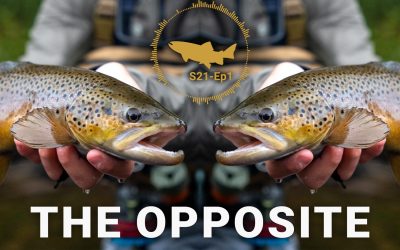



In my early years I became obsessed with rise forms. The variety of rise forms and eating styles in my (formerly) bug-rich waters was astounding, and I did my best to name/describe them all:
Dimples, nose pokes, heads, bites, rings, bubble rings, winks, swirls, bulges, splashes, spits, gulps, chomps, flushes (cavitations), explosions, kill shots, water clearing jumps, dorsal-tail humps, tail tips, and more.
As I gained experience, I came to the realization that using knowledge of rise forms and eating styles to help determine prey type select flies was only somewhat helpful. Not nearly as important as to what they revealed about feeding trout behaviors:
The mere presence of fish and bugs (duh), number and position of fish (pods v individuals), specific and often predictable feeding locations: feeding lies and lanes, station depth, stationary v mobile (searching, advancing), abundance of prey, frequency of eats, water displacement (i.e. fish size), mood: fearless v. skittish, hatch times and water types.
It took me too long to learn that:
Both teams have to show up – and cooperate. Blanket, river-on-fire hatches are extremely uncommon, in part because windows can be very short, but mostly they just are, especially given the current declines in aquatic insect populations on so many waters.
If mayflies duns are on the surface, don’t tie on a dun imitation unless trout can be observed eating duns. Don’t just assume they are because you see duns floating downstream and rise forms around them.
One-and-done risers are usually a waste of time, but not when prospecting
Accurate inspection of the drift is often dependent on specific currents and seam lines.
Garbage feeders, smutters, and the TDS hatch can be maddening
Small trout are the most selective hatch feeders; the bigs are more often than not opportunistic.
When head-hunting or prospecting, they will always reveal themselves
The holy grail is a very large, steady, happy (fearless) dun eater.