


In the past few months, extra rain created overflowing rivers that provided the perfect classroom for high water fishing. To me, it was a welcome weather pattern, an enjoyable deviation from the last half-decade of fishing my favorite watersheds under less than average flows.
Weather systems seem to set in for a while — for months, seasons or years at a time. And my home region easily soaked up the precipitation and greedily accepted it into the aquifers, until even a quarter-inch of rain could push topped-off creeks over their banks. But the color settled quickly too. And it was a joy to wade and fish my favorite waters under big flows that were reminiscent of some great rivers I’ve fished in Montana.
High water does not necessarily mean muddy water. And in the last few months, I fished valleys here that had three to four times their average flow, but with great color.
More water means more food and more opportunity for a trout to use the whole river, from bank to bank, for feeding in the drift and for ambushing bigger food forms.
Fish the Edges?
Focus on the edges. Surely, this is the most common advice for approaching high water. It’s a great starting point, and it makes a lot of sense. Especially when a river quickly doubles in flow, trout often move to the perimeter to pick off baitfish whose territory has been relocated. Worms and insects that are washed into the currents are another easy meal that trout search for at the borders.
So, fish the edges when big flows are recent. Fish the edges too when water clarity is at its worst, because slow seams near the bank often have the best chance to clear up, as sediment falls out of the current.
And let’s not forget that fishing the edges is a great option under any water conditions. Even at low flows, trout set up on bank lines for the cover — for the structure. Baitfish and crayfish congregate near the edges. More ants, beetles, crickets and grasshoppers fall in near the bank. And in some areas, perimeter flows may be colder or cleaner with additions from tributaries or spring seeps.
However, given high water with decent clarity, I do not fish the edges any more than normal. And during the last few months here, I’ve caught more trout in the main flow than in the bank water.

Cicadas
Our seventeen year cicada came and went during this period of the highest water I can remember. And trout rose consistently through big water for big bugs. Day to day, I caught far more trout in the primary seams than I did at the edges.
The few anglers I encountered on our rivers primarily fished the edges or the soft flats and pools. I fished all of that too, so I can tell you, objectively, the best water for fooling a trout with a cicada was riffly or choppy, from one to three feet of depth, and traveling at a fast-walking pace.
Yes, I caught trout in every water type, but after a month of fishing most every day with only a cicada dry fly and covering one to two miles of river with every trip, I know where trout were most interested in cicadas
READ: Troutbitten | On Your Own Terms
Streamers
I’ll transfer a lot of what I learned while throwing cicadas this time over to my streamer game. I have a habit of fishing the banks with the long flies, especially during high flows. And it makes sense, for reasons I mentioned above. But I have plenty of memories of wading through dirty water to reach prime spots in the middle of the river — boulders, buckets, drop offs and rock bars — while hooking the best trout of the day on a streamer.
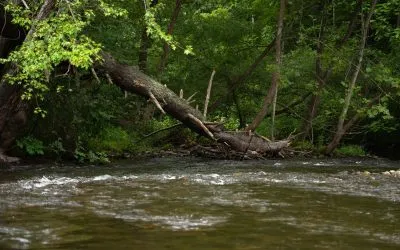
Great holding water can still be excellent at higher flows. A fallen sycamore stuck in the riverbed creates potholes and ditches around it that trout love to hold in and hunt around. Those same zones remain, even when the water is double the flow. The surface current might be traveling much faster, but the sheltered pockets below remain constant.
READ: Troutbitten | Where to Find Big Trout: Part Four – The Permanent Structure
Wade It
In these conditions, wading skill is probably more important than casting skill. Our ability to move through belt-deep water with confidence opens opportunities that escape most angler who are fishing the edges only because it’s comfortable, and not because it’s the best strategy.
Fish hard, friends.
** Donate ** If you enjoy this article, please consider a donation. Your support is what keeps this Troutbitten project funded. Scroll below to find the Donate Button. And thank you.
** Subscribe to Troutbitten and follow along. (It’s free.) **
Enjoy the day.
Domenick Swentosky
T R O U T B I T T E N
domenick@troutbitten.com





Dom, great article and that ability to wade confidently and safely is highly undervalued I believe.
I can echo the point you make about clarity. We caught many fish in mid stream lies at seriously high flows when we had a few feet of visibility. But the edges yielded the best fish when there was limited (12” or less) visibility. Crazy how the fish were just “on” the cicadas regardless of the flows.
I like the idea of taking this understanding into the streamer game moving forward.
Cheers Dom and thanks for the insight!