


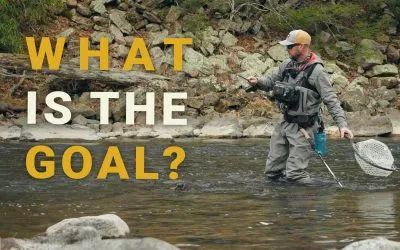
How should we approach a piece of river? What should we cover, and for how long. Should we wade up just one lane or go across the river?
These are all good questions, because a river angler wants to make the most of each piece of water.
Here are a few ideas and guiding principles that work for me every day on my rivers. I don’t try to cover everything. I don’t make grids, but I do make plans. I like to stay creative and follow the signs that trout give me. And for my wading approach, I break things down into three simple strategies: the typewriter, the zig zag and following up one lane.
Watch the video below. Then scroll below, for a little more about each approach.
(Please select 4K or 1080p for best video quality)
If you enjoy this video, the best way to support the effort is to like the video and subscribe on YouTube.
First, here are three more Troutbitten videos and articles that really pair well with these concepts:
VIDEO: Troutbitten | Reading Water — Levels, Lanes and Seams
VIDEO: Troutbitten | Finding Your Best Fishing Angles
VIDEO: Troutbitten | Casting Forehand and Backhand
The Typewriter Approach
Straight across the river, then reset, move up a bit and go across again. That’s what I call the typewriter approach. It keeps you behind your target trout at all times, so you don’t spook fish before casting to them. It’s a great strategy when other approaches, like following up one lane, might spook the trout on the far bank.
The typewriter is also my favorite approach when dealing with bad light conditions. Looking left or looking right — one is usually much better than the other. And on many days, I’ll work to the left all morning, simply because I can see into the water better. So I’ll work to the left, all the way across the river. Then I’ll reset to the right, move upstream 10-20 feet, and repeat the process.
I do this most often in medium to fast water. Because, in slower water, spooking trout that might go tell their friends about you is a bigger concern. (We call this the Paul Revere effect.)
The Zig Zag Approach
Working across and upstream, getting to the far side and then flipping over to fish the other direction — that’s what I call the zig zag. It uses both your forehand and backhand casting angles. It keeps you moving and covering water most efficiently. That’s why it’s my favorite way to approach the water.
I love the zig zag in pocket water most. But it works great as long as you can wade most of the water. The zig zag is best when like angles allow for looking left and right. And it’s a great way to cover a lot of water quickly and thoroughly.

Follow Up One Lane
When I catch one trout, I expect to catch another one just in front of it. And if the next trout eats the fly just five feet upstream of the first, then I tend to follow that lane all the way up to its origins.
Trout stack up in lanes, and that’s how they see the river — not horizontally, from bank to bank, but vertically, from upstream to downstream. And we see this all the time. One, two, three trout or more in a row, all in the same lane. So whenever the river setup makes it possible, I tend to follow the lane and trust it to the head.
When does this one-lane strategy fail? If I feel like following up just one lane will put me too close to water that I haven’t covered, in neighboring lanes for example, then I revert to the typewriter or zig zag.
Creativity
As I mentioned in the video above, I like to be creative on the water. I enjoy the flexibility of following the signs of a river. If I get two hits and land a fish in one lane, you can be sure I’m either following that one lane upstream or I’m looking for the next piece of water that is just like it.
After a handful of data points (fish eats) I start to see the river for how it is that day. I learn what is prime water and what might be secondary. And some of the water I simply will not fish. The secondary stuff I’ll spend short time on, as I’m wading to the prime stuff. And when I get to the prime water, I slow down, give it more casts, and I might even change flies or tactics there.
Eventually, if what I thought was prime water produces nothing for a while, then I reset my expectations and start the process anew.
Find feeding fish. That’s the goal out there. And these three strategies for covering water help dial it in.
Fish hard, friends.
** Donate ** If you enjoy this video and you enjoy Troutbitten, please consider a donation. Your support is what keeps this Troutbitten project funded. Scroll below to find the Donate Button. And thank you.
Enjoy the day.
Domenick Swentosky
T R O U T B I T T E N
domenick@troutbitten.com




Great stuff, Dom. Would your strategy change if you had a dry dropper on? For example, when following a seam up, I might stop for a bit and fan my casts out 45 or even 90 degrees, then immediatly return to following my seam up. Or would you call this ineffcient if I didn’t already see a fish further to the side? Thanks, Toney
Cool question. As long as I can land both my nymph and the dry in one seam, I might fan the cast out, yes. But I still use these strategies, regardless of the flies or the tactics. How will we cover the water, how will we approach it? Assuming wading is necessary, then these ways to cover it always apply.
Those are my thoughts.
Cheers.
I like this. I don’t follow one seam nearly enough. Regardless of wether or not I am catching fish the seam or lane that I am not fishing always looks the best.
What is your preferred approach on streams that are 2 rod lengths or less in width? It seems to me that either the typewriter or single seam are the only viable options.
As always great video. Thanks!
Right on. Narrow water like that, I usually pick the side with the best light angle and just work upstream from that side. No need to get into the middle until you reach some obstruction or are forced into it.
Hi Dom,
Can you recommend sun glasses for sight fishing
Here ya go … full article on the topic:
https://troutbitten.com/2021/05/19/polarized-sunglasses-for-fly-fishers-why-when-and-what-kind/
Cheers.