


Good anglers are observant students of all conditions. A flowing, wild river changes constantly, from water flows to water temperatures, from high sun to the next patch of dark clouds on the horizon. Resident trout respond to changes in their environment, and we’d do well to meet trout at these crossroads.
The availability of food is another observable change. Bug life in and around the river is one of the most prominent and easily apparent variables that changes quickly, and no angler can miss a thick hatch of mayflies or a swarm of caddis over the water.
However, on many days, trout simply do not rise in enough numbers to make dry fly fishing a viable option, no matter how many adult insects fill the air. And why should they? For every dry adult above the surface, imagine how many nymphs are emerging, drifting or staging near the bottom. All of these nymphs are an easier and more predictable target, so trout surely take advantage of hatching insects below the surface even more than they do above.
Trout don’t miss much. They know the hatches and the timing because they’re constantly immersed in the signs and signals of a river and the life inherent. It’s their world, and they’re better in tune with a river than the most frequent angler.

Photo by Tyler Boroff
Match the Nymph Hatch?
So what about matching the hatch, from a nymphing perspective?
Match your fly pattern to the prevailing insect — this is ingrained into the ethos of fly fishing. Certainly, it makes sense on top, because trout rise for a reason, with a purpose to eat a Sulfur dun or to capture bankside grasshoppers. Not only can we see what trout are taking, there are often just one or two insect types available, top water, at any given time.
Now contrast that with the underwater world. When the next Blue Winged Olive hatch starts, olive nymphs are abundant in the flow, but there are a host of other bugs joining them — cress bugs and scuds, along with crawling stoneflies, drifting mayflies and every caddis that will hatch in the next few months. Not every river is blessed with such fertility, but in bug-rich environments, options abound underneath, no matter what’s happening up top. Even given infertile streams, the unseen world of a trout holds plenty of surprises that are simply unknowable to the angler. And most times, trout have plenty of food opportunities below the surface.
Therefore, consider the complexity, and don’t ignore the hatches. Instead let them inform your next decision about what nymph you’ll tie to the upper tag in a two-fly rig. But don’t slavishly fish a pair of Hendrickson nymphs either, just because Hendricksons were listed on the hatch chart from your local fly shop.
What’s hatching? The answer to that question is a great starting point for choosing the size, profile and color of your next nymph (qualities in that order of importance). But if the results of matching the prevailing hatch with a nymph are meager, then be ready to think outside the box. Choose any reasonable nymph that inspires, and fish it well. Often, I fish two nymphs, keeping one of them as a good match for the most active insect, while the second is a match for another available food form, whether the pattern be general or specific.

Photo by Tyler Boroff
Do It
Perhaps the best advice I received on all this was from Steve Sywensky, at my local fly shop, when I was learning so much, a quarter of a century ago.
I asked Steve about nymph selection, because I was enamored with every new pattern that I’d read about or seen in the latest issue of Fly Fisherman magazine.
“Dom, I have a handful of confidence flies, maybe five or six nymphs. And every time I go out there, I rotate through those nymphs to see what trout want to eat that day.”
That was Steve’s advice.
Keep it simple, and don’t make too many assumptions about what’s available down below. The bug most visible and available in the air might not be what takes the trout’s attention underneath.
It’s a solid approach.
Fish hard, friends.
** Donate ** If you enjoy this article, please consider a donation. Your support is what keeps this Troutbitten project funded. Scroll below to find the Donate Button. And thank you.
Enjoy the day.
Domenick Swentosky
T R O U T B I T T E N
domenick@troutbitten.com




A few weeks ago I was nymphing one of my favorite stretches for wild browns among the sparse holdover stocked fish. After catching one stocked rainbow and no other bites, I found my hook snagged a green caddis larva. Just for fun I selected a green caddis nymph from my box and fished it. Shortly after on a nice tail out I netted a wild brown. Coincidence? It likely was but I was happy to match the hatch.
Hi Mike,
I love taking those signals too. Why not tie on that green larva, right?
To be picky here, I wouldn’t call that matching the hatch, though. You snagged a nymph on the bottom of the river. There were no caddis hatching, right? So you simply matched an available food form that you’d have known nothing about if you hadn’t snagged one. That’s not hatch matching. That’s just giving trout a look at available food.
Cheers.
Dom
Ah, got it!
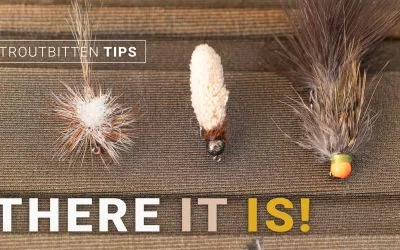
All of the artificial nymphs in the photos you attached to his essay lack something that characterizes many nymphs today: beads. Are you implying that a headless nymph does a better job of matching either the appearance or the behavior (i.e., drift) of naturals that are hatching or dreaming of hatching? If that is the case, do I assume correctly that, should you wish to fish these flies in the lower strata of a river, you fish them with split shot?
Hi Alex,
The second photo has a black beadhead fly. I’m not implying anything, really. And the article isn’t really about what patterns we should use to match flies, it’s much more about whether matching the hatch underneath even matters, or are we sometimes led astray by what we see up top? I do believe that unweighted nymphs without beads drift more naturally, and I fish that style often, yes often with split shot and sometimes trailing a beadhead fly. No, they aren’t always low at all. That’s a very different topic. But split shot doesn’t mean we’re always fishing low.
Last thing here, I do think the trend of over sizing a bead for the fly has been taken pretty far into abnormal territory. Sure, these flies with poor proportions catch trout, but I would use them only for good reason and specific purpose. Generally, I’d rather fill my box with flies that have the size and shape of the naturals, with realistic proportions. Beads can surely be used in a way that they don’t take over the fly. The second photo is a perfect example.
Cheers.
Dom
There are only 3 sub-surface flies. Waltz,pheasant tail,midge.
This article encapsulates so much of what I have learned from you and the crew over the years and it has made me a far better and more confident angler…my fly box is a lot simpler and my fishing is better.
Simplicity,Grasshopper
Hey now! Great article Dom, good food for thought. Love the pics, Tyler ties some awesome patterns!
Any chance you might share the stone fly pattern?