PODCAST: Dry Fly Skills Series #3 — Casting and Mending — S12, Ep4

by | Aug 25, 2024 | 7 comments

 The Troutbitten Podcast is available everywhere that you listen to your podcasts.

** Note **  The Podcast Player, along with links to your favorite players is below.

Our discussion here is about casting dry flies, and that’s where all good fly casting starts. With a dry fly, there’s no weight at the end of the line to help us out. No split shot, no tungsten bead, conehead or bobber. Refining the dry fly stroke truly teaches us what the fly rod is built to do.

Ten and two. Acceleration and crisp stops between two points. Pause and allow turnover to happen. Feel the rod load and watch it all happen with the fly line in the air. Once you have that timing, your baseline is set, and you can take that same stroke to any rod angle, punching the fly around and laying things out just how you want them with a few adjustments.

Good mending is setup by good casting. Put the two together, and you can feed slack to a dry fly for perfect drag free drifts.

Having command over all of it . . . is a lot of fun.

My friend, Matt Grobe, joins me to for a great discussion on casting and mending dry flies.

Resources

READ: Troutbitten | Category | Dry Fly Fishing
READ: Troutbitten | Ten and Two
READ: Troutbitten | Put More Juice in the Cast
READ: Troutbitten | Five Tips for Better Mending

Listen with the player above, or . . .

Find the Troutbitten podcast on any of these services:

— Apple Podcasts
— Spotify
— Google Podcasts
— Amazon Music
. . . and everywhere else where you listen to podcasts.

You can find the dedicated Troutbitten Podcast page at . . .

podcast.troutbitten.com

Season Twelve of the Troutbitten Podcast continues next week with episode five. So look for that in your Troutbitten podcast feed.

Fish hard, friends.


** Donate ** If you enjoy this podcast, please consider a donation. Your support is what keeps this Troutbitten project funded. Scroll below to find the Donate Button. And thank you.


Enjoy the day.
Domenick Swentosky
T R O U T B I T T E N
domenick@troutbitten.com


Share This Article . . .

Since 2014 and 1500+ articles deep
Troutbitten is a free resource for all anglers.
Your support is greatly appreciated.

– Explore These Post Tags –

Domenick Swentosky

Central Pennsylvania

Hi. I’m a father of two young boys, a husband, author, fly fishing guide and a musician. I fish for wild brown trout in the cool limestone waters of Central Pennsylvania year round. This is my home, and I love it. Friends. Family. And the river.

More from this Category

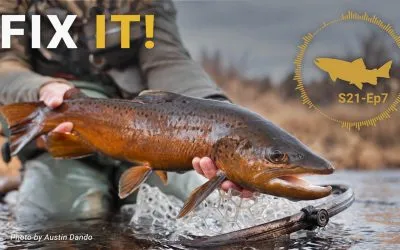
PODCAST: Fly Casting Fundamentals and Failures – S21, Ep7 (VIDEO and AUDIO)

PODCAST: Fly Casting Fundamentals and Failures – S21, Ep7 (VIDEO and AUDIO)

A good day of fishing almost always comes down to casting. So does a bad day of fishing. Without good form and accuracy, you wear down and become physically tired. You’re frustrated by the snags and tangles that come with bad casts . And you walk away knowing that you really didn’t hit the target enough to give yourself a chance.

In this conversation, we cover the fundamentals of solid casting for river trout. We talk about how to become an accurate caster, and we cover the most common mistakes.

PODCAST: Small and Light Nymphs — Rigging and Fishing – S21, Ep5 (VIDEO and AUDIO)

PODCAST: Small and Light Nymphs — Rigging and Fishing – S21, Ep5 (VIDEO and AUDIO)

Surely, the most common advice for fooling more selective fish is to go smaller with the pattern. Often that’s a good strategy that meets the moment . . . but not always.

When we do want to fish smaller flies, how do we go about it? The fact is, larger flies drift differently. Heavier flies can get down more quickly. And getting a #18 into the strike zone really requires a different strategy.

What Is the Troutbitten Project? (VIDEO)

What Is the Troutbitten Project? (VIDEO)

Give me a few minutes to tell you about the Troutbitten Project. This endeavor has taken roots and grown branches. Troutbitten has grown into a large independent media company, with 850+ articles, 200+ podcasts and 120+ videos. It’s also a guide service, and there’s a Troutbitten Shop.

Here’s a quick look at where we’ve come from and where we’re going . . .

PODCAST: Wader Care and Wader Repair – S21, Ep3 (VIDEO and AUDIO)

PODCAST: Wader Care and Wader Repair – S21, Ep3 (VIDEO and AUDIO)

This podcast is all about about your waders — wader care and wader repair. You might think that if you take care of your waders, they’ll last forever, but that’s surely not true. All of us in this conversation have been fishing long enough to have gone through many, many waders. We’ve also been in the game long enough to know how to patch waders. I’m constantly surprised by how many anglers tell me they got a pinhole in their waders, so they sent them back. That’s not how it used to be. Every die hard angler that I knew used to have a good supply of Aquaseal and they knew how to use it.

So here are our thoughts and experiences about taking care of your breathable waders and patching them effectively when the inevitable happens.

What do you think?

Be part of the Troutbitten community of ideas.
Be helpful. And be nice.

7 Comments

  1. Harvey Leaders are the best!!

    Reply
    • Hi
      For dry flys are you still using your 10 ft 4 wt rod?
      Thank you!
      Love what you do

      Reply
      • Yes, absolutely. That’s one of the reasons I choose it. Because the rod I carry does everything I would like, without compromise.

        Reply
  2. Dom,
    When mending the line and leader should my goal for the leader be 30%, 50%, 90%? The obvious reason for my question is the more leader I try to mend the more I move the fly.
    Thanks,
    Scott

    Reply
  3. Guys : Do you have a rod dedicated only to dry fly fishing? If so would you cut the loop off the fly line and either snell ,splice, nail knot or blood knot the Harvey to the fly line and would you based on stiffness change your transition piece connecting fly line to Harvey. Would you change that transition piece if you went from 4 wght to 5 or 6 weight
    Lastly have you any thoughts on Double taper versus weight forward lines and how they compare and impact the Harvey’s performance

    Reply
  4. Great podcast! I think I do a lot of these mends, but there’s a lot more I can learn here. One thought: have you thought of shooting a drone video showing the various mends? An overhead view of how the line travels over the water would give me a good sense of the angles you use. Cheers, Toney

    Reply

Submit a Comment

Your email address will not be published. Required fields are marked *

Recent Articles

Recent Posts

Pin It on Pinterest