


We’re in an extended high water period in Central Pennsylvania. Honestly, I love it. When the creeks are full the trout are happy, and so am I. I’ve heard the lament of so many anglers across the region about unfishable conditions and poor results. But that’s not the reality I’m in. And if the water clarity is decent — if the trout can see the flies — I’ll take high water over low water every time. Success in such conditions just takes some discipline to fish what you can, and leave the rest.
Sure, blown out water is a bust, and there’s really not much you can do about that. But I’m not talking about muddy water and flood conditions. So far this fall season, we’ve averaged flows that are two or three times the norm for this time of year. But consider that our fall water is usually pretty low, and you might suddenly become thankful for the opportunity to fish a creek with some decent water coming through.
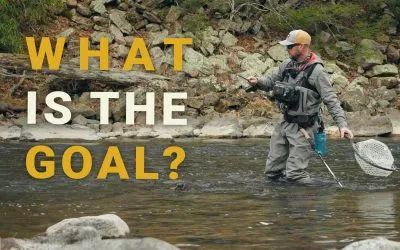
No matter the river or the flows, good fishing happens by staying within your effective reach. Fish within your means. If you are only comfortable in water that’s knee-deep, then find water below your knees and fish only what you can reach from there. Try hard not to fall into the grass-is-greener-on-the-other side trap.
More green. More grey.
When Dad and I traveled to Montana many years ago, our first stop was the Madison River. After a forty-hour drive, I remember being so anxious to hit the water that I geared up twice as fast as Dad did in the gravel lot. Usually I’m an angler who walks in for some distance and observes the water, but I forgot about all that and waded directly into river fifty yards from the truck, while Dad was still tying his boot laces.
Ten feet off the bank, I was up to my thighs. Another ten feet put the water at my waist. I struggled to reach the middle of the river so I could hit the green-grey undercut on the other side. Floundering in a river now up to my stomach, I punched long casts with a #10 Humpy through the unforgiving wind, adding more power until I finally touched the target water with my yellow fly. The fly dead drifted for about a foot, then my dragging leader ripped it out of the zone. Over and over, I pushed big casts and long-arm mends across the river to reach water I was sure was the prime lie in this run.
It probably was.
But from the corner of my eye I saw Dad casually walk down to the creek. He stretched a little and took it all in — content with the realization of our trip plans come together. Months of preparation and forty hours of driving had led him right here, to the Madison River.
Dad stayed on the bank, across from me and among the dry sage brush. He knelt in the dirt and fired a few fifteen foot casts at the average water near the bank.
“Hey, I got one!” Dad yelled happily as he stood up and played the trout.
Of course he did.
I wasn’t stubborn for long. By the end of that first evening I understood that success on our first trip to the Madison would mean recognizing the water I could fish, picking apart the first thirty feet or less off the near bank — treating it like Spring Creek in Bellefonte, near my home — and ignoring the rest.

Fish hard
Everywhere and anywhere
I’ve had the same experience in many rives, and I’m sure you have too. Maybe it’s a river like the Madison, large and swift enough that it’s never really wadeable enough to cover all the water you’d like. Or maybe it’s a small creek like my home water that’s recovering from recent heavy rains. As it comes back down into shape, the fishing can be tremendous — if you stay within your means.
Target only what you can fish effectively. Forget the fifty foot casts, and look for fishable water within reach. In a good river, trout are found all over — not just in the green-grey undercut.
Fish hard, friends.
Enjoy the day.
Domenick Swentosky
T R O U T B I T T E N
domenick@troutbitten.com






“Been there, done that” on the Madison. I fished it late May, with fierce winds, and horizontal snow. The river was running bank-to-bank, about 4,200 CFS. So I just fished from the bank, and caught two 18″ ‘bows and two identical length browns. I figured, “Why get wet, when the fish are at my feet?”
Right on.