Fly Casting Curves (VIDEO)

by | Aug 13, 2026 | 0 comments

** NOTE ** Find the YouTube Video Below

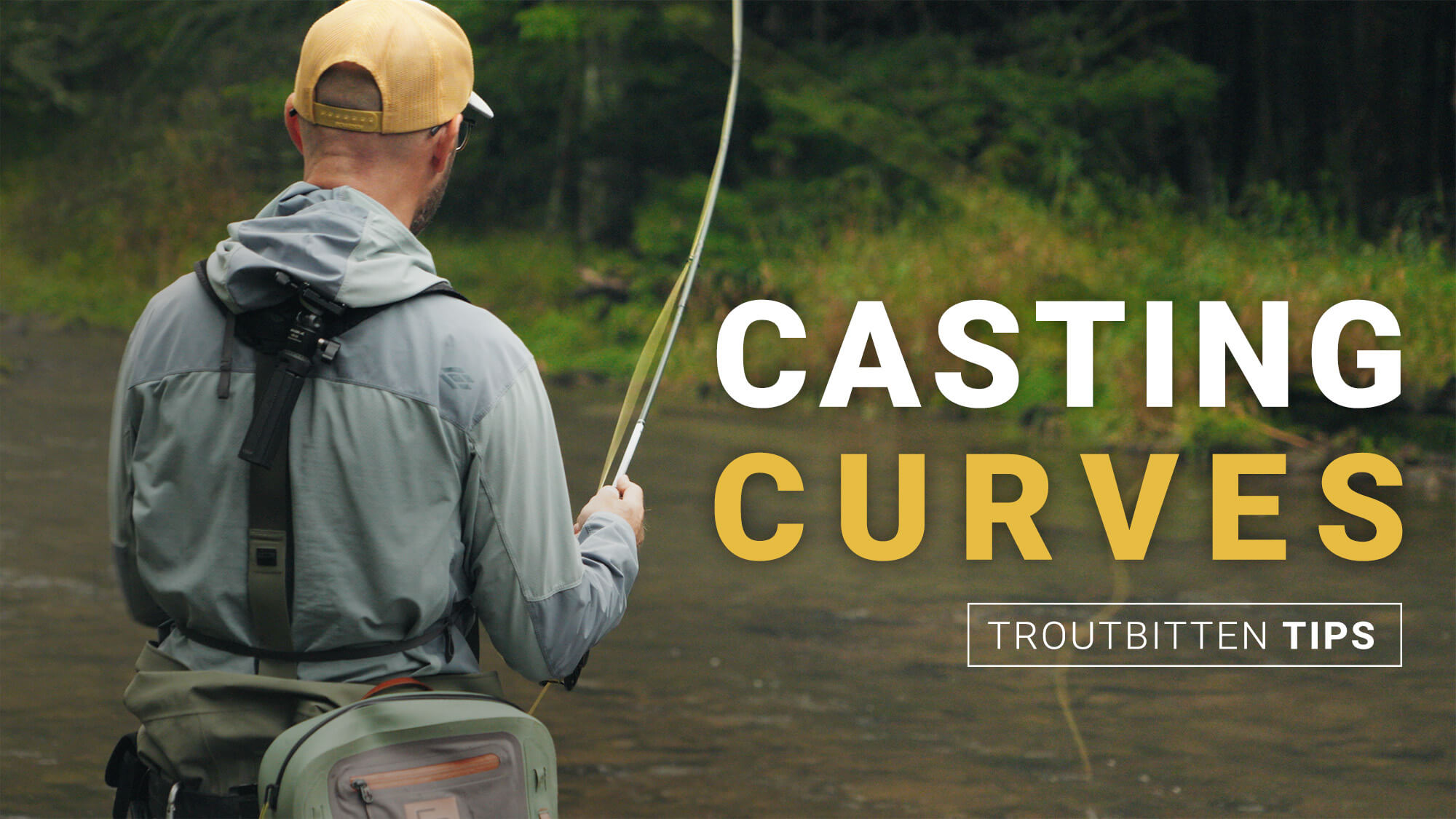
The ability to cast curves into your line and leader might be the most unique thing about fly fishing. Of course we can choose where we want the fly, but we can also choose where and how we want the line , leader and tippet to land.

Think about that.

Where we place these curves completely dictates how the fly will drift — how it will travel. Casting curves are fundamental in how we present the fly. This matters up top, when we put slack in the leader for a dry fly. And it matters underneath, whether we’re dead drifting a nymph, swinging a wet, or fishing a streamer.

There are two types of fly casting curves: a power curve, and the one no one seems to mention, the lagging curve. Understanding both leads to a complete set of skills to match any situation with a fly rod. Mastering these concepts — and these casts — can change everything on the water for you.

Resources

VIDEO: Troutbitten | Casting Forehand and Backhand
ARTICLE/VIDEO: Troutbitten | The Lagging Curve Cast – Dead Drifts for Days
ARTICLE: Troutbitten | Dry Fly Fishing – The Forehand and Backhand Curve
ARTICLE/VIDEO: Troutbitten | Dry Flies In Fast Water – Fly Fishing Tips
ARTICLE: Troutbitten | Design and Function of the Troutbitten Standard Mono Rig
VIDEO: Troutbitten | Turnover and The Tuck Cast
ARTICLE: Troutbitten | Fly Fishing Strategies – The Tuck Cast
ARTICLE: Troutbitten | The Crash Cast

(Please choose 4K or 2K for best resolution.)

(If you enjoy this video, please like, subscribe and leave a comment on YouTube. It makes a difference.)

Find all of this stuff in action in the Fish and Film videos on the Troutbitten YouTube channel

VIDEOS Troutbitten | Playlist | Fish and Film

** Donate ** If you enjoy this article and video, please consider a donation. Your support is what keeps this Troutbitten project funded. Scroll below to find the Donate Button. And thank you.


Enjoy the day.
Domenick Swentosky
T R O U T B I T T E N
domenick@troutbitten.com


Share This Article . . .

Since 2014 and 1500+ articles deep
Troutbitten is a free resource for all anglers.
Your support is greatly appreciated.

– Explore These Post Tags –

Domenick Swentosky

Central Pennsylvania

Hi. I’m a father of two young boys, a husband, author, fly fishing guide and a musician. I fish for wild brown trout in the cool limestone waters of Central Pennsylvania year round. This is my home, and I love it. Friends. Family. And the river.

More from this Category

PODCAST: Fly Casting Fundamentals and Failures – S21, Ep7 (VIDEO and AUDIO)

PODCAST: Fly Casting Fundamentals and Failures – S21, Ep7 (VIDEO and AUDIO)

A good day of fishing almost always comes down to casting. So does a bad day of fishing. Without good form and accuracy, you wear down and become physically tired. You’re frustrated by the snags and tangles that come with bad casts . And you walk away knowing that you really didn’t hit the target enough to give yourself a chance.

In this conversation, we cover the fundamentals of solid casting for river trout. We talk about how to become an accurate caster, and we cover the most common mistakes.

Don’t Be Afraid of the Bottom (VIDEO)

Don’t Be Afraid of the Bottom (VIDEO)

With a nymph, most trout are caught near the bottom. That’s not a surprise. Most of the good things in a river happen near the riverbed. That’s where the bugs and baitfish live. And nothing solves the problems of nymphing better than getting lower for longer.

What Is the Troutbitten Project? (VIDEO)

What Is the Troutbitten Project? (VIDEO)

Give me a few minutes to tell you about the Troutbitten Project. This endeavor has taken roots and grown branches. Troutbitten has grown into a large independent media company, with 850+ articles, 200+ podcasts and 120+ videos. It’s also a guide service, and there’s a Troutbitten Shop.

Here’s a quick look at where we’ve come from and where we’re going . . .

The Hook Set and Go (VIDEO)

The Hook Set and Go (VIDEO)

I use a ten-inch hook set — fast not far — at the end of every drift. And I use this for all underwater presentations. This is not just about setting the hook. Instead, this simple motion — this quick lift up and over — gets the fly activated. It releases surface tension and gets the fly moving, preparing it for the backcast.

What do you think?

Be part of the Troutbitten community of ideas.
Be helpful. And be nice.

0 Comments

Submit a Comment

Your email address will not be published. Required fields are marked *

Recent Articles

Recent Posts

Pin It on Pinterest