


Most of the trout are holding and feeding in shallow bank water from six to twelve inches deep. It’s the stuff you’ve been walking through all morning, ignoring the edges in favor of the deeper runs and shadowy, irresistible guts. You couldn’t bring yourself to believe that trout would hold in the skinny stuff, let alone feed in such water, so you skipped it.
Then, on the long walk out, along a bankside path, you spook at least a dozen fish in a hundred yards, all holding in calf-deep water that’s mostly slow and right near the bank. There are so many fish, in fact, that you start creeping along the edge of the bushes with measured stealth, until you finally find a trio of trout holding and feeding bankside, doing what they do in a place that you never expected would hold a fish. But trout make their own decisions.

— — — — — —
Days later . . .
Your standard confidence nymphs will not produce this afternoon. It’s frustrating. And this lack of production has you questioning everything you thought you knew about fly fishing and wild trout. Now you’re reaching for the corners of the fly box, grabbing for flies that haven’t seen action since last season and hoping against hope that something will turn at least a fish or two.
Good tight line tactics always work here. But not today. So you blame it on extra angler pressure and curse the picky trout as you swap out leaders and tippet, going thinner and slimmer, because that’s what you’re supposed to do, they say. But none of it works, and you’re really not surprised.
With fifteen minutes left before the real world catches up to your fishing trip, you clip the top nymph and tie on a dry fly, because . . . well . . . why not? There have been zero rises all day, but here you are, now fishing a tight line dry dropper rig.
It works. And in the next fifteen minutes, six wild brown trout, all in the mid-teens, confidently take your #14 CDC & Elk. Over and over they come to eat the dry, in the kind of water where you couldn’t buy a fish all day.

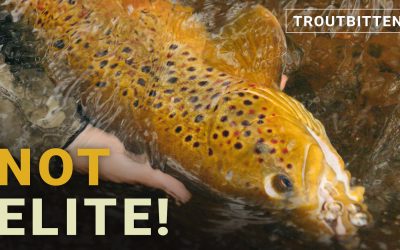
River and a wild trout.
— — — — — —
On another trip . . .
Swinging flies has never been your thing. You’re a dead drift guy, because that’s what trout eat. They’re looking for a natural presentation, one that holds a seam brings the fly to them. And a swinging fly, crossing currents and fighting the flow just doesn’t look realistic. It won’t fool these educated wild trout.
At the end of a particularly bad run of luck, you grab your line from another tree limb and start clipping apart the nest of impossibly woven 5X. “Wonderful,” you mutter. “The fish won’t feed again, and here’s another day of knot tying practice in wading boots.”
After the re-rig, you let the line and two flies dangle downstream on a twenty-foot leash of monofilament. As you check a text from your buddy who’s fishing upstream above the island, a hard jolt nearly steals the rod from under your arm, and you’re fast and tight to the largest trout you’ve seen in months. He pops off about ten seconds into a tough fight, and you realize that you never had a chance at landing this accidental fish anyway. What was he doing eating a dangling fly in the mid-current? “That was so random,” you say out loud.
With the excitement over, you begin to read the text from your friend again:
Great action while swinging flies! With a nymph on bottom and a wet up top. They’re eating both. A lot! Who knew?
The similarity is undeniable. So with renewed enthusiasm, you rebuild your rig, stop blaming the trout and start swinging flies downstream. Then, for a couple of happy hours, you hook up with a trout every few casts.

Photo by Austin Dando
— — — — — —
There are preferred presentations and favored approaches on the rivers. A dead drift is clearly the best way to fish a dry fly — most times. A one-seam approach catches trout on nymphs — usually. And getting a streamer through the top third of the water column fools more fish — most days.
But when any of that fails, when everything you expect to work produces nothing, never blame the fish. Think more. Try harder.
When your tight line approach with a pair of nymphs looks good but leaves the net empty, then don’t settle for good. Make it perfect. Never blame the fish.
No matter the situation, don’t blame your lack of success on the trout. It’s easy to believe that the fish aren’t feeding. (It surely makes us feel better.) And it’s a comfortable solution for walking away with your ego intact — just mail it in and tell yourself the fish aren’t hungry today.
It’s easy to think that there’s nothing we can do in these slow times, so we tip our cap and surrender. But don’t give up. Believe always in the next change: the next water type, next rig adjustment or the next fly. Fishing trout rivers is a puzzle. It’s always different, with the Etch-a-Sketch shaken anew every dawn. The answers are there. And the fish can be caught. Believe it.
Never give up. And never blame the fish.
Fish hard, friends
** Donate ** If you enjoy this article, please consider a donation. Your support is what keeps this Troutbitten project funded. Scroll below to find the Donate Button. And thank you.
Enjoy the day.
Domenick Swentosky
T R O U T B I T T E N
domenick@troutbitten.com









Very good thoughts. One of your best articles for the thoughtful fisherman my friend.
Thank you.
I was there and got skunked this past week on the Farmington in CT. My problem is that i simply don’t have enough confidence in the “standard presentations” to assume that they are failing because they don’t work at this point, as opposed to me doing something wrong with the standard approach. And i’m sure this is the case for many of us.
Sure thing. And there’s nothing to accelerate that process but fish and do so attentively. Once you do have confidence that your presentation is excellent, then you can take the next step and change things.
Cheers.
Dom
I feel this one. This has been my past month, cycling through water types and techniques until I figure it out. Seems no two days have been the same, even in the same spots.
For sure
Great article Dom! It reinforces “if it doesn’t work, change!” One of the largest trout I caught was on a dragged midge nymph as I was moving to a new spot. I had little luck all morning so was getting frustrated. Needed a moment to consider my options and was moving to a rock to consider them. Wham, out of the blue the fly I was dragging was hit. Started swinging flys after that and it rescued my trip.
Seeing River taking interest in the fish (licking one I believe) brought a smile to me. It is always best to fish with a friend.
Right on.
So, if I may ask…..”What was he doing” …..eating a dangling fly in the mid-current. We know they are predictable, sometimes, as we also know they are unpredictable, sometimes. Is that the only answer?
It’s happened to me…and all I got in return was a “L” shaped hook of my parachute Adams. So I ask again…..what the hell was he doing? Leaving his secure depression sanctuary beside a exposed rock, moving up current to eat a dangling Adams. I would listen to any explanation.
Thanks all. Have a great day.
My summary of Gary LaFontaine on this topic: “Why trout strike a fly.”
1. Hunger
2. Curiosity
3. Playfulness
4. Anger
5. Voracity/Opportunism
6. Reflex
Such are the moods of a trout.
There is a 7th: “Lock jaw” where weather and river conditions become something we can complain about if that’s you’re bent.
Hi Elwood. I truly think there is no explanation besides, it happens. You could take something like that and spend the rest of the day just hanging your fly in the water. It would likely produce nothing for many days to come. Instead, try to take some data from it, as in the story above, and direct the tactic to something reasonable.
Make sense?
Dom
Maybe its just me but sometimes (just not too often) I think the trout deserve to win.
The “warrior” mentality in the sport has gone over the top and maybe we should just dial it back a bit. But then again I’m a dry fly guy in a bug rich system and fully accept the handicap I’ve inflicted on myself. Trout deserve the sanctuary of the deep and the privacy of the night, IMHO.
Respectfully… I will continue to drag my black bugger to those deep dark sanctuaries in pursuit of those copper torpedoes
“Trout deserve the sanctuary of the deep and the privacy of the night, IMHO.”
Pretty good, buddy.
Reply
” Trout deserve the sanctuary of the deep and the privacy of the night, IMHO.”
I’m just not sure what this means. It sounds poetic, I’ll give you that. But the logical conclusion is that we shouldn’t fish deep water, right? And why is the night more sacred than daytime? Maybe we shouldn’t fish at dawn then, too? Is an hour after dusk too much? Maybe don’t fish on cloudy days? This makes no sense to me. As for the sanctuary of the deep, where’s the cutoff? Is 4 feet deep enough that I should not fish it?
We fish. We try to catch trout. That’s what we do. And if you want to experience a different, unique, truly original beauty and a feeling unlike another, fish enough at night to get comfortable with it. Then make some judgments.
Lastly, there is no “warrior mentality” here, and I don’t care for the mischaracterization. Fish hard should not be reframed as such. No thank you.
Dom
On the mighty Deschutes River here in Oregon we have a very robust Osprey population. All of the guides I use advise to not waste time on shallow (under two feet) unless late evening or under the cover of a tree as the Osprey will pluck them out of the gene pool.
Love the article as usual but find myself in a quandary given our Osprey factor. I would love to be wrong about this. So far my inspiration garnered from your articles has not yielded results for me in those near the bank shallow fishing scenarios. What am I missing?
Hi Eric,
I guess it just needs to be the right bank water. We have a lot of great shallow stuff here, and fish feed heavily. But I can think of a ton of shallow water here too where trout will almost never feed. It shouldn’t just be shallow. It must offer the protection of riffled water, a dark bottom or overhanging canopy. Make sense?
Dom
Hi Dom,
Like some of the other commenters, I really enjoyed this a post.
When swinging a nymph and a wet fly, is the nymph you use a beadhead nymph? (Or do you roll your eyes at this question because I should experiment with both beadhead and non-beadhead nymphs.)
Thank you
Ha. No rolling eyes. But yes, I do it many different ways.
Dom
Dom,
Great article. I just had my finest day fly fishing ever with the Mono Rig and my new 12’6 3wt. I caught over 10 trout over 16 inches and at least 10 more nice ones. None of it would have happened without your generosity. My friend, had the same results on one of your standard mono rigs as well. Can’t wait to fish with you next year.
Nice
This has to be most comprehensive post yet! Every single one of those scenarios I’ve experienced! Luckily,I fish same 2 miles of river,and basically have figured out every contingency possible,so rarely get blanked,but for the occasional guy,this river is vexing as hell. I do have to explore shallow water,tho.
Cheers.
Dom, I love that you bring these posts back up so we can read them again. This post is so core to how you have taught me to approach this passion.
Cheers, buddy. I also enjoy the reposts. It gives me a chance to go back and edit some earlier. Work. I feel like I can always do better. There’s always something to fix.
Cheers.
Dom
Dom,
I love that you bring articles back up also. The days you describe reminded me of the day before I met you and fished with you back in May of 2020. I was fishing my 2nd day of the trip with my friend at Little J. We had success the day before in a different area but I was struggling through a late morning and early afternoon.
We saw some fish eating on the surface. I was fishing the side shallows and the deep and not even moving fish nymphing or swinging. I think you called me to confirm our meeting time for tomorrow and I shared my frustration. I believe you told me to keep covering water and trying a new thing or 2. You even gave me advice on a couple flies.
I gained renewed interest but confidence eluded me. I landed a small brown then another but I wanted to walk downstream to another run. I passed under the bridge we had fished completely and noticed a few fish eating on the surface now. So I added a dry on top which was a sulfur tied for me that morning my my friend. Kept going downstream and let my friend have that hole. Now he only landed 1 and lost another during the day, so he was also frustrated. In the hole below I landed a medium brown on the dropper in faster pocket water. Worked my way back to up Blake and he said he couldn’t get a take. Its less than 10 minutes from dark now and I look at his rig and he is using the same dry with a walts worm dropper.
We hear a healthy slurp under the bridge and he says I give up, you try. In the second drift a trout eats my dry, the same fly he tied and I bring in an 18 inch brown. We barely got a picture of it from lack of light in the sky. The only real difference between us may have been I still felt opportunity and I was a rod length downstream, so maybe a more upstream cast with the dry. But that day ended with the largest fish of our trip because I re-organized and kept my head in the game. Thank you for your insight then and now.
Best Regards,
Rick
Love it.
Dom