Building the Troutbitten Mono Rig – Reels, Lines, Materials, Connections and Knots (VIDEO)

by | Sep 23, 2026 | 0 comments

** NOTE ** Find the YouTube Video Below

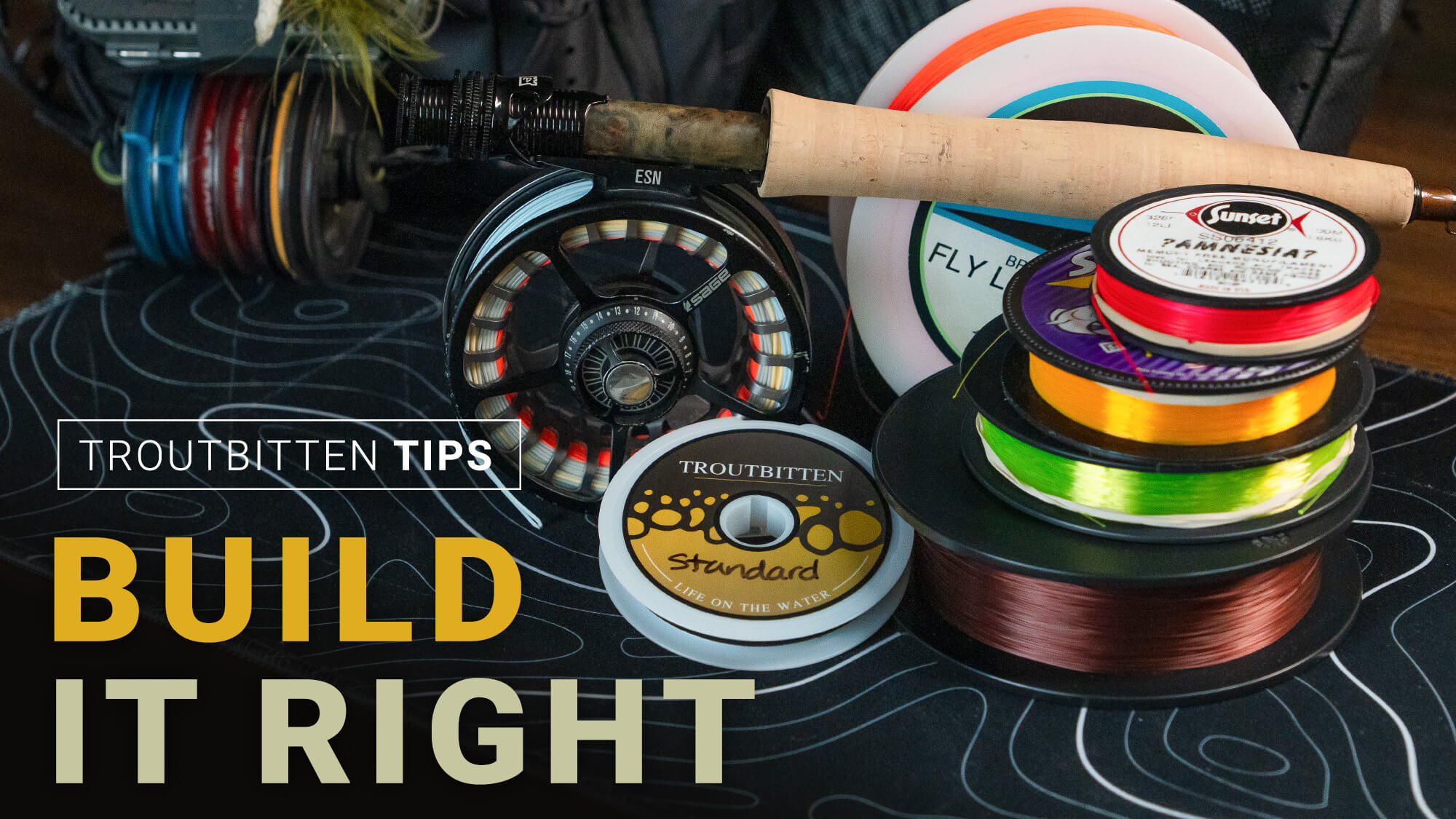
For over a decade, I’ve written and talked about fishing a Mono Rig for all underwater presentations — nymphs with and without an indicator, with and without split shot, dry dropper, streamers of all shapes and sizes and even pure dry flies. I’ve detailed the formulas for my favorite leaders in many places, but I’ve never put everything together from the ground up. This video answers the most frequent questions about reels, fly lines, leader connections, materials and knots. No matter what tight line leader you choose to build, the principles shown here apply.

Here’s the Video Timeline

0:00 Intro
0:40 Other Resources
1:34 Reel Choice and the Pinky Cradle
2:10 Fly Line Choice
3:28 Leader Attachment
4:09 Butt Section Materials
5:24 Thanks to Poncho
5:57 Fly Casting the Mono Rig
6:45 Taper and Sighter Materials
9:07 The Leader Build
12:27 Tippet Rings
15:00 Leader Storage
15:28 The Backing Barrel
16:00 Stretch Every Leader

Resources

VIDEO: Troutbitten | Mono Rig Mods
ARTICLE: Troutbitten | Design and Function of the Troutbitten Standard Mono Rig
VIDEO: Troutbitten | Lightning Fast Leader Changes
VIDEO: Troutbitten | Floating the Sighter
ARTICLE: Troutbitten | The Backing Barrel Might Be the Best Sighter Ever
ARTICLE: Troutbitten | Loop to Loop is Bad – Try Attaching Your Leader This Way

Here’s the video . . .

(Please choose 4K or 2K for best resolution.)

(If you enjoy this video, please like, subscribe and leave a comment on YouTube. It makes a difference.)


** Donate ** If you enjoy this article and video, please consider a donation. Your support is what keeps this Troutbitten project funded. Scroll below to find the Donate Button. And thank you.


Enjoy the day.
Domenick Swentosky
T R O U T B I T T E N
domenick@troutbitten.com


Share This Article . . .

Since 2014 and 1500+ articles deep
Troutbitten is a free resource for all anglers.
Your support is greatly appreciated.

– Explore These Post Tags –

Domenick Swentosky

Central Pennsylvania

Hi. I’m a father of two young boys, a husband, author, fly fishing guide and a musician. I fish for wild brown trout in the cool limestone waters of Central Pennsylvania year round. This is my home, and I love it. Friends. Family. And the river.

More from this Category

Don’t Be Afraid of the Bottom (VIDEO)

Don’t Be Afraid of the Bottom (VIDEO)

With a nymph, most trout are caught near the bottom. That’s not a surprise. Most of the good things in a river happen near the riverbed. That’s where the bugs and baitfish live. And nothing solves the problems of nymphing better than getting lower for longer.

PODCAST: Small and Light Nymphs — Rigging and Fishing – S21, Ep5 (VIDEO and AUDIO)

PODCAST: Small and Light Nymphs — Rigging and Fishing – S21, Ep5 (VIDEO and AUDIO)

Surely, the most common advice for fooling more selective fish is to go smaller with the pattern. Often that’s a good strategy that meets the moment . . . but not always.

When we do want to fish smaller flies, how do we go about it? The fact is, larger flies drift differently. Heavier flies can get down more quickly. And getting a #18 into the strike zone really requires a different strategy.

What Is the Troutbitten Project? (VIDEO)

What Is the Troutbitten Project? (VIDEO)

Give me a few minutes to tell you about the Troutbitten Project. This endeavor has taken roots and grown branches. Troutbitten has grown into a large independent media company, with 850+ articles, 200+ podcasts and 120+ videos. It’s also a guide service, and there’s a Troutbitten Shop.

Here’s a quick look at where we’ve come from and where we’re going . . .

The Hook Set and Go (VIDEO)

The Hook Set and Go (VIDEO)

I use a ten-inch hook set — fast not far — at the end of every drift. And I use this for all underwater presentations. This is not just about setting the hook. Instead, this simple motion — this quick lift up and over — gets the fly activated. It releases surface tension and gets the fly moving, preparing it for the backcast.

My Streamer Approach (VIDEO)

My Streamer Approach (VIDEO)

I’d like to show you my basic steamer approach. There are a lot of animations that I give to a streamer — a lot of looks. And I use plenty of different fly patterns too. I have my favorite leader and even my favorite water types. But there are a few things that I think are more important than any of that.

So let’s get to the basics. I’ll show you some of the guiding principles for how I fish streamers. Some of this is a little different — not exactly mainstream.

Lane, Depth and Speed – What Matters Most In a Nymph Drift (VIDEO)

Lane, Depth and Speed – What Matters Most In a Nymph Drift (VIDEO)

When a nymph disappears under the surface, it’s easy to settle for a drift that’s merely good enough . . . but we shouldn’t. Underwater currents are complex, and a convincing nymph drift depends on three things: lane, depth and speed. No matter the rig — tight line or indicator, Mono Rig or fly line — we must understand what the nymph is doing and make deliberate choices about its path. And while all three elements matter, trout are more particular about some drift qualities than others. In this video, I break down each element and rank them by importance, with one goal in mind: better dead drifts and more consistent fishing.

What do you think?

Be part of the Troutbitten community of ideas.
Be helpful. And be nice.

0 Comments

Submit a Comment

Your email address will not be published. Required fields are marked *

Recent Articles

Recent Posts

Pin It on Pinterest