


** NOTE ** Find the Companion YouTube Video Below
Here’s a look at fishing dry flies in faster water — in more complex currents — because there’s a unique set of skills to get true dead drifts in the fast water and pocket water. The drifts are shorter and harder to achieve. But some of the best fish hang out in faster stuff, and if you give them a great presentation you have a really good chance.
It’s a fun challenge, and if you can get great drifts here, you can do it anywhere.
In this video, I cover three main skills that help meet the particulars of fishing dry flies in fast water. Those skills are also detailed below the video, in the article, with links to further Troutbitten resources.
Here’s the video, and the article continues below . . .
(Please choose 4K or 2K for best resolution.)
Lagging Curve and the Crash Cast
Tension to a dry fly causes drag. So the goal of any good dry fly angler is to keep the leader and tippet from influencing the dry. A Harvey Dry Leader is my favorite tool for building slack into the whole leader — not just the tippet section — for excellent presentations that feature slack and grace in all the right places.
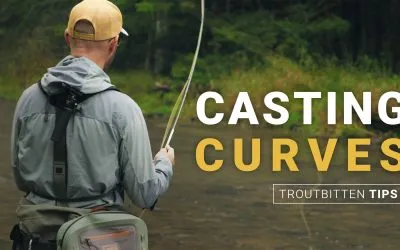
The slack leader design of the Harvey leader is the perfect match for a Lagging Curve cast. There is simply not better way to get excellent drifts on a dry fly. Josh and I did a full video on the lagging curve.
ARTICLE/VIDEO: Troutbitten | The Lagging Curve Cast – Dead Drifts for Days
That curve achieves in the air what many anglers attempt with a mend after the fly hits the water. The Lagging Curve is a pre-mend. In faster water, the Crash Cast is a modified version of the Lagging Curve, where all of the slack hits the water fast, with the dry fly landing immediately after. The Crash Cast is therefore a Lagging Curve solution for even the fastest water.
These two casts are fundamental, baseline skills. They are not specialty casts. They are all the time cast in the fast stuff. Otherwise, the following skills do not matter.
READ: Troutbitten | The Crash Cast
READ: Troutbitten | Dry Fly Fishing – The Forehand and Backhand Curve
Lay It Down. Pick It Up
Deliver a Crash Cast to the water, and then pick up the extra, leaving only what is necessary on the water.
In the fastest currents, you can be as close a you like to the trout, especially when you’re behind them. That proximity allows you to keep unnecessary line in the air rather than in the current, allowing for a true dead drift at close range.
Importantly, the pick up happens fast, right after the delivery. Build up the slack with the Crash Cast, and then pick up the extra.
The Hop Mend
Good mending happens only with a slack line. If the line is already straight, the dry fly will move. So after delivering the fly in fast water, with a Lagging Curve or Crash Cast, it’s easy to mend the slack and place it somewhere else.
The Hop Mend is perfect for this. These are short, quick mends that lift a length of leader but not the fly. Multiple short Hop Mends are more effective than one large reach mend because we can be more precise with where the line will be places in the complex currents.
I often Hop Mend all the way through the drift, just to keep the leader and tippet from being buried by the currents. Even though I always grease the leader in fast water, it can still be pushed underneath by swirls and whitecaps.
ARTICLE/VIDEO: Troutbitten | The Hop Mend
Do It
Remember that fast water, pocket water and complex water can be some of the best dry fly water out here, if you have the right approach.
Fish hard, friends. And have fun out there.
Find all of this stuff in action in the Fish and Film videos on the Troutbitten YouTube channel
VIDEOS Troutbitten | Playlist | Fish and Film
** Donate ** If you enjoy this article and video, please consider a donation. Your support is what keeps this Troutbitten project funded. Scroll below to find the Donate Button. And thank you.
Enjoy the day.
Domenick Swentosky
T R O U T B I T T E N
domenick@troutbitten.com





You could also approach from directly below, keeping fly line, leader, tippet and fly all in the same seam. Some of the best advice I ever got was to, mend with your feet.
Hi Rick,
Good stuff. I definitely agree with fishing with your feet. One of my guiding principles with this style is to keep moving, both for water coverage and positioning. A lot of what I’m doing when I lay it down and pick it up is very close and behind the trout. You can see some of that in the video and in many Fish and Film videos. Regarding getting fly, tippet, leader and line all in the same seam . . . for me, that’s just not possible very often in fast water. What I call fast water has too many currents that bend and swirl, and that line/leader on the water gets pulled around unless there’s significant slack in the system. What you mentioned works best for me in slower stuff. However, it’s all situational, and if we can see the dry fly floating well then it’s a success!
Cheers.
Dom
Interesting to see the speed of all this as well as how close you are fishing….
Right on.