


Our fly fishing gear takes a lot of abuse, and eventually all waders leak, boots fall apart and pack zippers fail. But how long can it hold up? How well is it built?
The 100 Day Gear Review Series on Troutbitten takes a look at how gear is performing after the century benchmark. Should our fly fishing gear last longer than 100 days? You bet. And after many months of heavy use, we can have an excellent understanding of what we bought.
The gear reviews on Troutbitten feature products I’ve used extensively and believe in. These reviews are an honest account and reflection of my time spent fishing with these products. I fish hard, and I tell you no lies. That’s the way it is here.
READ: Troutbitten | Category | Gear Reviews
** Note ** Links for buying the Skwala RS Boots are at the end of this article.
(Your support is appreciated.)
Skwala recently launched their RS boots, checking every box on my wish list for the perfect wading boot.
In early spring, the Skwala team sent over one of the first pairs of RS boots to come off their production line. I’ve now put over 100 hard river days on them (116, to be exact), so I have the miles of experience in these boots to give you the run down. In short, these are the best wading boots I’ve ever worn. And they’re easily my new favorite.
The RS boots are exactly what I was hoping for when I learned of Skwala’s plans for wading boots to match their mission of delivering innovative, durable and comfortable gear that’s truly built from the perspective of die hard anglers.
After all these days on the water, the RS boots show remarkably little wear. No seams are failing, and the glue is holding strong (save a tiny flap on the toecap). Even the tread has held up over long river miles and extended hikes. I like to relocate and look for fishing opportunities. And because I’m an explorer at heart, I average two to three miles with each fishing trip.
Add that up. We’re talking about well over two-hundred miles on these boots, and the soles still look like this . . .
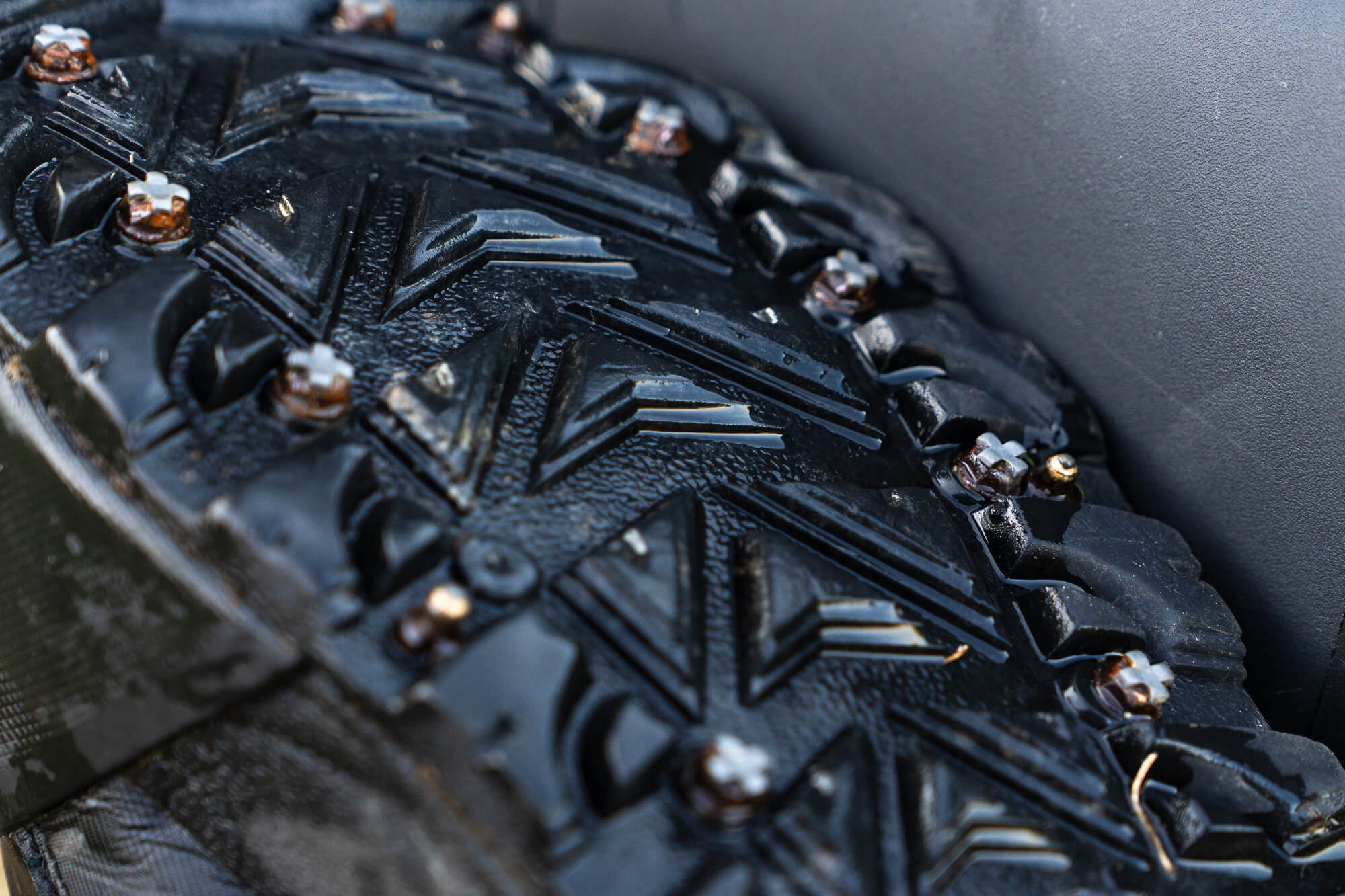
(The RS soles take Grips Studs and Orvis Posi-Grip studs well. I added a mix of both here.)
The support of the RS boots is one of my favorite features, and that too has held up well. While some high-dollar boots begin with the structure of a good hiking boot, their support falls apart into a mushy mess after a month of good wear. Not the Skwalas. The RS boots feel pretty close to the day that I bought them. Consider that my RS boots have rarely had time to dry out, and it’s clear that Skwala has built something special.
READ: Troutbitten | 100 Day Gear Review — The Skwala Carbon Waders
Goals
Kevin Sloan and Rich Hohne from Skwala know how much I love these boots. But I asked them one question for this article:
What were your key goals when designing the RS boot?
Here was their response . . .
Our goals were clear from the beginning:
— Build the most durable boot on the market—period.
— Make it light enough that you don’t feel like you’re lifting bricks all day.
— Lock in support and traction so you can fish aggressively on uneven ground, in fast current, or on remote hikes.
— Use cutting-edge materials and construction techniques that outlast traditional boots.
— Design it from the ground up as a piece of fishing equipment, not just footwear.
I’ve worn and worn out wading boots from every major manufacturer in our industry: Simms, Orvis, Korkers, Patagonia, Cabelas and LL Bean. What Skwala has with the RS boots is just different. I’m sure the RS will break down at some point, but Skwala achieved their first goal of building the most durable wading boots possible.
The rivers I wade are filled with sharp rocks and heavy currents. The wading is tough and the miles are long, so the rare combination of comfort, support and durability in the RS is appreciated.

Steps and Traction
The stepped lugs are another new design from Skwala. I stud all my boots for these rivers, but I wore the RS for a week without studs, just to try their novel idea. A good bite comes from angles of rubber digging into rocks, and Skwala’s stair-step lug pattern creates a multitude of right angles. I still don’t like boots without studs, but the RS are the grippiest I’ve worn.
Sizing
Every major brand seems to have a different take on boot sizing. Do you build a boot that’s a true size ten, or make sure it’ll accommodate a 5 mm neoprene bootie? Most brands do the latter, but their methods of measurement seem inconsistent.
Skwala recommends buying your street shoe size and sizing up for half sizes. I agree. I wear a size 9.5 or 10 shoe. And the size 10 Skwalas are just right for my foot. Late last fall, I received size 11’s as a prototype that the Skwala crew sent over. Conveniently, they were a good winter boot for me, because I could wear two or three pairs of wool socks for insulation.
If you do find your wading boots to be just a little big, throw an extra insole in there.
** HERE is a link to my favorite insole for wading boots. **

Lightweight, Heavy Duty
My demands for a wading boot have always started with great support and traction, so I’ve learned to live with the extra weight that usually accompanies such support. But somehow, Skwala kept the weight down. The RS are lighter than most when dry, but what really impresses me is how light they are when wet. These aren’t hiking boot materials thrown into wading boot duty. These are modern materials selected for shedding water.
The RS boots are not overbuilt. They’re purpose-built, for those who fish.
As Rich Hohne told me, “The RS boot is what happens when you start with a blank sheet and ask, ‘What do serious anglers actually need in a boot?’”
Nailed it.
Purchase
** Note ** The partnerships and the support of this industry are part of what keeps Troutbitten going. And I’m proud that Troutbitten is a Skwala affiliate. You can read my policy on gear reviews HERE. And if you decide to buy the Skwala RS Wading Boots, (or any other product at these links), Troutbitten receives a commission of the sale, at no additional cost to you. So thank you for your support.

** Buy Skwala RS Wading Boots HERE to Support Troutbitten **
Enjoy the day.
Domenick Swentosky
T R O U T B I T T E N
domenick@troutbitten.com


I love mine. I don’t have 100 days on mine yet, but I have many outings that I wore them for over 16hrs or more at a time. Nothing indicating that they are starting to fail. The only small complaint I have is that they take longer to dry out after a trip than any other pair of boots I have ever owned. Likely a product of their robust construction. Not an issue if you fish every day or every other, but if you are getting out every 3 or 4 days they can get a little funky smelling. I bought a cheap boot dryer. Problem solved.
Skwala has also provided me with EXCELLENT customer service when dealing with an issue I had with a pair waders. The waders didn’t have a defect, I abused them. They took care of me even though we both knew they had no obligation to do so. They are 1 of 3 companies in the industry that will in my opinion stand behind their products.
Good stuff. Thanks for recommending them to me Dom. Convince them to make a vest.
Good stuff. Tell them you want a vest!
What model / size Grip Studs did you install on the boot?
Hi Dom – great timing on this review as I bought a pair about 3 days ago!
Getting ready to install 3000B gripstuds – was going to install them on the nubs provided on the sole, but I see you have them installed on the flat of the sole – could you help with some advice on a fresh stud installation for these boots?
You could do it either way. 3000A have more protrusion.
3000A
Curious how you like them compared to the Orvis Pro boots. You had lots of good things to say in your review of them, which ultimately drove me to purchase them. Been real satisfied with them, though Orvis did have to replace them for me once already after the soles blew out 50 days in. I’ll stick with the Orvis for now. They’re great boots. But I’m keeping my eye out for what could be my next replacement when needed.
The Orvis Pros are great too. You can see the beginning of the failure in my review — outside around the little toe area. I get about 125 days on them, and that area fails. Gotta keep in mind, though, I put a LOT of hard miles on wading boots.
I’m sure they’re great-for $300+ they should be. But, it’s hard to give up my Korkers. The changeable soles are hard to beat. I don’t change them but a couple of times a year (If I’m gonna be in a drift boat), as my studded soles won’t be welcome in the boat.
The funny thing about Korkers is how many of those soles we find in the river or on the bank — multiple every year. It’s a running joke in our crew. I usually take a picture and send it to some friends. Good idea. Questionable implementation,proven out by how many “versions” of the soles there have been over the years.
That’s a little unfair. I have put a lot of miles on korkers and have had mostly great experiences. They also have extremely good customer service. I have lost one sole in well over 300 days on the water with my korkers. I stepped into knee deep mud that nearly ripped my leg off. Korkers sent me a new pair of soles free of charge. They also offer a 2 year warranty. The iterations on their sole attachment design is a good thing. It means they care. Every good company tweaks their product over time to maximize quality. You wouldn’t say a fly rod manufacturer puts out a bad product because they introduce a new rod line up every few years.
I have found a total of 4 fishpond nets in the last 2 years. Is it a fishpond design flaw or user error?
Korkers might not be perfect. I like my RS boots more, but Korkers are not bad boots.
Even 1 lost sole on 300 days is too many. Doesn’t work for me.
Hi Dom, looking at these seriously over the orvis pro that I have tried on at my local fly shop. The Orvis Pro seems a great boot but the Skwala seems to have more sidewall protection from the sole. This is a big factor for me. the streams that I wade are slippery freestone where I often get my feet jammed usually on the outside when stepping over larger boulders in the stream. Sometimes causing pain.
Whist I know both are good options and I have just purchased new Orvis Pro zipper front waders and have fell in love. So was kind of set on the boots to match but love the look of the Skwala sole that may suit my fishing better.
Cheers
P.S. love listening to your podcasts on the way to the mountains.
Cheers.
I picked up a pair of the RS boots based on this article and am really loving them. I have a knee injury flaring up which means my wading has been a little more unstable lately, so I am similarly thinking about adding studs to them. I read your review on GripStuds and was about ready to purchase, but then came back here and saw you used a combination of GripStuds and Orvis PosiGrips. What is the reason you went with the combination? Do you situations/conditions where the PosiGrips outperform what you outlined in your GripStud review?
Since it probably would influence your recommendation, I am typically on the Truckee/Little Truckee or other rivers in the Sierra Nevada and can hike in up to a few miles in my wading boots when necessary.
Thanks for all the care and details you put information you put out there. Its been an invaluable resource in my short fly fishing career.