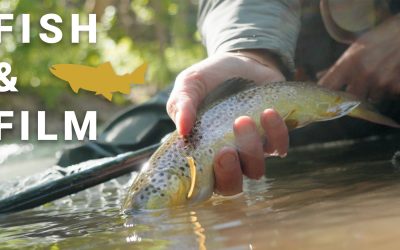
VIDEO: Riverside — Fishing Direction — Should You Work Upstream or Downstream?

by | Jun 19, 2025 | 2 comments

The way you approach the river and the angle that you fish influences everything about the way you present the fly.

Fly fishers have a lot of options for fly styles — so a good fisherman can show pretty much every food form that a trout might eat throughout the day. And That’s not just by changing the fly, it’s by also choosing the angle or the direction that we’re fishing in the first place.

Precisely because trout fishing in a river is so varied, there’s never just one answer or one way to do anything. Everything works sometimes. But what should you do most of the time? That depends a lot on your tactics.

I’ll make a pretty strong argument that most of the best trout fishing happens by fishing in an upstream direction. I fish dry flies, nymphs and streamers while working upstream. And one of the only times I choose to work downstream is when I’m swinging something. For me, that’s usually wet flies and it’s usually at night, after dark, with a pair of big wets or a swung streamer.

So I work upstream about ninety-five percent of the time.

After all the articles, podcasts and videos since 2014, I still get comments from people who wonder why I fish upstream, because they work downstream, and  they catch a bunch of fish. I’m sure they do!

But here are some good reasons for fishing upstream. Some are about presentation, some are about trout habits. Some are undeniable and some are just personal preference.

I published an article a couple years ago about all this, and this Riverside video is borrows from that text.

Here’s the article:

READ: Troutbitten | The Advantages of Working Upstream

Here’s the video, and the audio will publish next week.

(Please choose 4K or 2K for best resolution.)

Fish hard, friends.


** Donate ** If you enjoy this article, please consider a donation. Your support is what keeps this Troutbitten project funded. Scroll below to find the Donate Button. And thank you.

READ: Troutbitten | Category | Fly Casting

Enjoy the day.
Domenick Swentosky
T R O U T B I T T E N
domenick@troutbitten.com


Share This Article . . .

Since 2014 and 1500+ articles deep
Troutbitten is a free resource for all anglers.
Your support is greatly appreciated.

– Explore These Post Tags –

Domenick Swentosky

Central Pennsylvania

Hi. I’m a father of two young boys, a husband, author, fly fishing guide and a musician. I fish for wild brown trout in the cool limestone waters of Central Pennsylvania year round. This is my home, and I love it. Friends. Family. And the river.

More from this Category

Fly Casting Curves (VIDEO)

Fly Casting Curves (VIDEO)

There are two types of fly casting curves: a power curve, and the one no one seems to mention, the lagging curve. Understanding both leads to a complete set of skills to match any situation with a fly rod. Mastering these concepts — and these casts — can change everything on the water for you.

Dry Flies In Fast Water – Fly Fishing Tips (with VIDEO)

Dry Flies In Fast Water – Fly Fishing Tips (with VIDEO)

Here’s a look at fishing dry flies in faster water — in more complex currents — because there’s a unique set of skills to get true dead drifts in the fast water and pocket water. The drifts are shorter and harder to achieve. But some of the best fish hang out in faster stuff, and if you give them a great presentation you have a really good chance.

In this video, I cover three main skills that help meet the particulars of fishing dry flies in fast water. Those skills are also detailed below the video, in the article, with links to further Troutbitten resources.

Tight Line Dry Dropper and Fishing the “Y” (with VIDEO)

Tight Line Dry Dropper and Fishing the “Y” (with VIDEO)

There’s a lot to be done with this system — many different ways to fish, with presentations that go far beyond what is commonly shown and talked about. This is not Euro dry dropper. And we’re not fishing within the constraints of rules and regulations that stem from the competition scene.

Instead, by taking a broad look at what’s possible with a tight line dry dropper approach, fly choice, leader design, weight position and rigging methods all open up into a set of tactics that are more fun and lead to more trout at the end of the line.

What do you think?

Be part of the Troutbitten community of ideas.
Be helpful. And be nice.

2 Comments

  1. The Smith Creek fly box has some nifty features. I went to their website, and it’s not listed there. Any word on when this will be available?

    Reply

Submit a Comment

Your email address will not be published. Required fields are marked *

Recent Articles

Recent Posts

Domenick Swentosky

Central Pennsylvania

Hi. I’m a father of two young boys, a husband, author, fly fishing guide and a musician. I fish for wild brown trout in the cool limestone waters of Central Pennsylvania year round. This is my home, and I love it. Friends. Family. And the river.

Pin It on Pinterest