


From the broken oak tree I turned south and navigated around the mass of fallen timber. An enormous old-growth trunk had buried a handful of younger trees when it crashed down and crippled a few others. I stopped to admire the explosion of limbs and chunky bark. Dry, rotting wood and new green samplings had stretched to their end before slicing off into bent spears that stuck in the dirt. All of it created an impasse that started on the riverbank and extended beyond the water’s edge. So I went around.
The morning was young, and frost held onto everything within a foot of the forest floor. The fall season had grown old — enough that most leaves were already released from their parent branches. I noted the washed-out colors, so different than what I’d seen here just eight days before. And I thought about what would come next — a white canvas mixed with a wet dark-brown forest. Rich evergreen boughs would be snow capped and bending over the ever-flowing river. All of these colors would stir in with the water’s limestone-tinted grey-green.
I’m thankful for the change of seasons. I spent two months shy of a year, living and working three-hundred miles south of here, out of the Appalachian mountains and removed from my native, mixed, four-season range. Winter was a dreary experience in the south, with a bit more rain and a lot less daylight than summer, but not much else. I missed the snow and the new beginnings offered with every turning season. So I moved back. And I’ll never leave this place where the earth changes so predictably. Because seasons offer new chapters and force old reflections, with a simple walk in the woods.
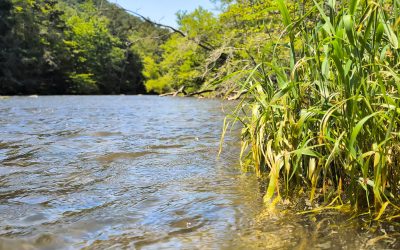
Beyond the fallen oak and back to the river’s edge, I moved slowly to the tailout, scanning for rising Olives all the way downstream. None yet. And so I found my seat at the base of a familiar hemlock, directly across from the limestone lip and a few hundred yards upstream of where the river bends ninety degrees east, creating the heaviest pocket water for miles, as it slams against the mountain and mixes with fallen boulders that dot the riverbed.
The white noise of heavy water created a soft backdrop, whispering with a volume floor low enough to provide accent for all other sounds.
Frosty leaves crackled as I sat on the mixed moss and hemlock roots. I sunk into a pillow of more leaves and moisture. The streamside earth was in transition. Not yet frozen, it released a warmth that created the frost each morning and mixed into fog on others. The next time I visit this place, I thought, it will no doubt be changed again.
I sat. And I laid the fly rod across my knees like a hunter with a rifle. I waited and watched. I scanned the river and sank deeper into the mossy earth until my breathing pattern evened out. My heartbeat slowed and recovered its normal pace, having accelerated on the walk in. I was warm and content. I sat with a stillness reserved for moments like these and watched only with my eyes. The silence calmed me until I could feel the blood pulsing beneath my skin. I sat, alive and aware, eager and anticipating, serene and satisfied all at once. Still.

Photo by Austin Dando
During this timeless sit I first noticed the starlings above. High over the flat water, they performed aerial acrobatics to take the Blue Winged Olives, one after the other, hovering and swooping, diving and darting, seeming to enjoy their own moment as much as I enjoyed mine. And the rising rings followed. Dotting the water’s surface, trout noses poked through the reflection of grey sky and bare branches.
Content and patient, I waited longer than usual. I scanned the tailout and then moved for the first time in — who knows how long? I tilted my head to align the horizontal bars in my polarized lenses, and I cut the highlights on the water’s surface.
There.
From this angle, I could see each shape underneath the dots, every trout in the ring of the rise. And I saw him immediately. Just upstream of the lip and sunk into a minor depression of the riverbed, a waving tail gave away his position even before his next rise. Twice the size of any other trout in the area, this wild brown was an old friend of mine.
I’d followed him for two years. He’d rejected my best efforts during a sulphur spinner fall last May, and I ran out of daylight before solving the puzzle. I may have hooked him twelve months ago during a night fishing adventure to this same tailout. Fishing a large streamer just below the surface, whatever took my fly erupted to break the silence of the dark. It ran fast toward the ninety degree bend and the pocket water below. Within seconds, my line went limp, and the trout was gone. The last I saw him was in June, when he twice chased my streamer. On that rainy day, the rising river filled with color, and I fished through a heavy thunderstorm.
Still sitting on the moss and hemlock roots, I watched my target rise a dozen times in the tailout, and I judged his rhythm against the pulsing beat of my heart.
Finally, I stood and walked to the river. Never taking my eyes from the trout, I plucked the #18 Olive Parachute from its hook keeper and stripped enough line to meet him. I edged as close as I dared, wading slowly into the tailout up to my ankles. And then I stopped. I breathed deep and sighed long. After accelerating the rod tip in two full arcs, the line was on its way. I watched the olive dry fly turn over in the mist and flutter down to the water. It landed in perfect alignment, two yards upstream of the large, rising trout, and with all the necessary slack given to a #18 hook.
The moment, the cast and the timing was perfect . . .
Enjoy the day.
Domenick Swentosky
T R O U T B I T T E N
domenick@troutbitten.com







…and????????????
Beautiful Dom, I feel like I’m standing in your boots.. Your words always capture the magic that we struggle to articulate
Thanks, Mike!
I agree with John, and??? However we live for the pursuit and the “take” validates our efforts. Probably best left unsaid.
You’re a big tease. Is this story to be continued…..
Ha! For all who wanted the ???? the story ends that I never caught that trout.
The memory for me was the experience of getting there and the possibilities.
I do realize that an editor would never accept that, though. Ha.
Dom
Looking forward to part two. Right when it started to get juicy!
Part Two:
Never caught ’em. Great drifts though!
Dom
I think Dom’s point is, that it doesn’t matter how the story ends because everything else – the setting, the weather, the foliage, the hatch, the steady feeding elusive trophy, the rise form, the fly, the approach, the cast, the drag free drift, the anticipation – everything was perfect. Whether he hooked and landed it this elusive trophy became irrelevant in light of this seemingly spiritual experience. On second thought . . .
Yeah, on second thought, the rest of the story!
That’s just about perfect, Rick.
I expect chapter 2 soon, the tippet strength, the take, the set, the fight and the …
To the ???’s: “success” / pleasure does not always equal a trout in hand. Why limit the enjoyment of an outdoor, stream side experience to only a caught trout?
I get it, but it was still like the end of episode 1 on a Netflix series!
Good point.
You fished through a heavy thunderstorm??? Waving a lightening rod around???
Yes. I took my chances and lived to tell about it.
Your life is nothing to gamble with.
Thanks for the love, Bob!
Dom
Nice piece Dom.
Thanks, Tom.
Ahh…we are left to our own imaginations….absolutely acceptable!
We are left to our own imaginations…absolutely wonderful!
Thanks for reading.
Dom
Heard a podcast today with an interview of Tom McGuane where he talks about the encounter, the entry into nature. The eat is part of it… Beautiful story!
Cheers.
“Because seasons offer new chapters and force old reflections, with a simple walk in the woods. “ I’m feeling it. Thanks