


The fly is an explorer tied to the end of a string. It bounds along with the current, making discoveries and telegraphing its collected information back through a line. Whether nymph, streamer, wet or dry, our fly is an investigator sent forward to probe the water and search for trout — and to collect more information than our eyes can see.
Standing riverside, pinching the hook of a caddis dry fly between forefinger and thumb, with slack line and a rod poised to send our fly on a mission, we scan the water for signs. We look for rising trout and likely holding lies. And we look for much more than is easily visible. The currents of a rocky, rolling river are a converging and confusing mix. And what we may decipher through polarized lenses is a mere scratch of the surface. So we send a pioneer.
We release the caddis dry from our grasp, flick the wrist and propel the explorer forward to a target. And when the fly lands, we learn. It dances slower in a lane than we thought it might. And, provided enough slack, it discovers a minor back eddy, momentarily traveling upstream with its hair-wing sails before it is tugged and rushed along an unnatural course, forced to follow the dragging reins.
But now we know. Now we understand the flow, the mixed currents, more than we could ever see from our distant position. And on the following cast, we take a different aim. We vary the distance, lending another twelve inches of length. And we vary the angle, tossing the slightest aerial mend after the forward check of the rod. And with an artful turn of the wrist we create an upstream arc for those twelve inches of extra tether. Our fly finds the bubbly edge of the inside eddy, and our drawn arc lands along the rolling seam. So while the fly dips and swirls with its hair-wing sails, the arc unfolds. The caddis swoons for an impossibly long moment, and a trout is convinced. The fly disappears into a hole, engulfed by the dark mouth of a wild trout from below.
That arc — our variation — succeeds because we learned about an invisible current, because the fly served as prospector. And with every cast we have another chance to watch, to discover more about exactly how the river is flowing and just where the trout may be feeding and waiting to strike.
The dry fly is a scout.

Photo by Chris Kehres

Photo by Chris Kehres
Enjoy the day.
Domenick Swentosky
T R O U T B I T T E N
domenick@troutbitten.com


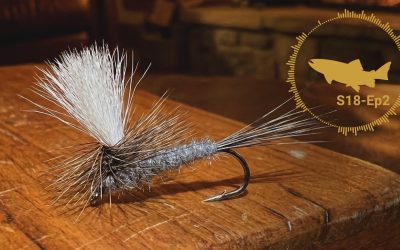
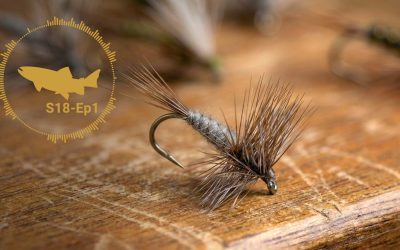


My favorite scout dries, in no particular order:
Royal Wulff
Deer Hair Sedge ( a very sparse caddis)
Stimulator (especially in smaller sizes — 12 to 16)
X-Caddis (see above).
Parachute Adams
Typical scenario:
Stick one of these in a likely spot and see if you get a reaction. Not necessarily a strike but a reaction.
Get some interest? Good. Now take a seat and watch for a little while. While you’re doing that attach some tippet to the dry and tie on something like a March Brown soft hackle or one of those kebari reverse-hackle Tenkara flies. Or something like that.
Then work up to it again.