One Great Fly Casting Tip

by | Apr 11, 2018 | 2 comments

I guess I take casting with a fly rod for granted. It’s not that I’m some fantastic caster or that I don’t have my struggles. But in truth, I can usually put the fly where I want it. And after all these years watching good and bad casting from other anglers, I believe the difference comes down to one key element — speed.

My own education happened naturally. Over a period of years, fishing day in and day out, I developed a casting technique and style that works for me. But it took time, and I know that not everyone has such a luxury. Inevitably, for the anglers I meet who struggle to cast a fly, whether working with a dry line, tight line nymphing, or casting wets and streamers, it comes down to one thing — they aren’t aggressive enough.

The fly rod needs an angler to take control and be bossy. Good casting requires acceleration between 10:00 and 2:00, with hard, deliberate stops at those points. That’s what I mean by aggressive. The cast should be crisp. It must stop between two positions, and it must stop with purpose. The casting stroke should never be lazy, and it should not be cautious. Otherwise, fly placement and accuracy falls apart.

As we approach overhanging limbs near a riverbank, being cautious is the worst thing to do. Caution is accompanied with a slowdown of the rod speed. And when we’re too careful, the line loops open up, the leader sails high and the fly sticks in a tree.

Speed | Force | Flex

Decades ago, my Dad was the first friend whom I ever taught to cast a fly rod. And his trouble was the same as what I still see every day while guiding clients. Most people who cast a fly just aren’t aggressive enough. All good fly casting needs acceleration and hard stops at 10:00 and 2:00. I touched on this before in a Fifty Tips article, but the point here is to be deliberate. Be confident. It’s not enough to stop at 10:00 and 2:00. Between those stops there should be purpose, speed and force to get the rod flexing. That’s how we take control of the cast. And that’s how we place the fly exactly where it needs to go.

I may have lucked into learning all this. When I look back at my own history, I realize that a lot of things lined up for me, charting a logical course toward a full picture of the fly fishing game.

My fly fishing experiences started on small waters. I fished for wild brookies and brown trout in the headwaters. I explored brushy, woodsy streams with my Border Collie, on an endless quest for new adventures. Those wild places filled me up inside. The vacant, lonesome and deep woods of Pennsylvania forests were a refuge — and they taught me good fly casting.

I used a short, seven foot leader with a four or five weight fly line. And I learned to punch the line and leader under branches and guide the fly toward a target, around wet logs and greedy limbs. I quickly realized the concept of 10:00 and 2:00 was only a starting point. I cast sidearm and backhand, with circle casts, water hauls, roll casts and whatever angles necessary to boss the line, leader and fly toward one point on the water.

READ: Troutbitten | One Great Nymphing Trick

Regardless of the particular type of cast, I learned that it should be done with force and purpose. There must be speed and acceleration in the cast, accompanied by crisp, clean stops. Anything less, and I ended up in the trees. If I cast softy — if I was too cautious — I was asking for trouble.

Now, all these years later, this is still my best fly casting tip. Whatever you’re casting (dries, nymphs, wets or streamers), do it with some speed in between two points. Cast with authority. Don’t be the butterfly. Be the bee.

Fish hard, friends.

Enjoy the day.
Domenick Swentosky
T R O U T B I T T E N
domenick@troutbitten.com


Share This Article . . .

Since 2014 and 1500+ articles deep
Troutbitten is a free resource for all anglers.
Your support is greatly appreciated.

– Explore These Post Tags –

Domenick Swentosky

Central Pennsylvania

Hi. I’m a father of two young boys, a husband, author, fly fishing guide and a musician. I fish for wild brown trout in the cool limestone waters of Central Pennsylvania year round. This is my home, and I love it. Friends. Family. And the river.

More from this Category

Where’s My Fly?

Where’s My Fly?

Understanding the fly’s position — where it is and where it’s going — is the key challenge in fly fishing. And aside from basic casting skills, an awareness of the fly in the current is the most essential skill.

Rain-X  As A Pre-Treatment

Rain-X As A Pre-Treatment

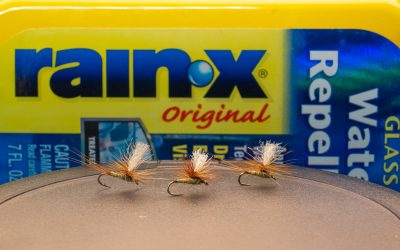
I apply Rain-X to all dry flies that leave my vise, if they don’t have CDC. I do the same with my yarn indicators. A simple drop of Rain-X dries completely in a few hours, leaving behind an unseen film of silicone that goes a long way to waterproofing materials for the river. I’m surprised more anglers don’t know about this. And no, Rain-X is not toxic after it dries.

PODCAST: Dry Fly Platforms – The Outliers and The Wrap Up – The Troutbitten Fly Box (S18, Ep7)

PODCAST: Dry Fly Platforms – The Outliers and The Wrap Up – The Troutbitten Fly Box (S18, Ep7)

This Troutbitten Skills Series and these platforms are an effort to pass along the idea that fly selection doesn’t have to be regimented or complicated. Instead, see flies for what they have in common. Find their similarities rather than their differences. Choose the elements that matter most to you. Find the components of a fly that create enough of a distinction to be the keys to a platform, and build around that idea.

PODCAST: Dry Fly Platforms – Hoppers, Stones and Foams- The Troutbitten Fly Box (S18, Ep6)

PODCAST: Dry Fly Platforms – Hoppers, Stones and Foams- The Troutbitten Fly Box (S18, Ep6)

It’s time for the big-meal dry fly platform: hoppers and stoneflies. With this platform, we substitute subtlety for buoyancy. Hackle is traded in for rubber legs, and dubbing is often replaced by closed-cell foam. In this episode, we break down this big-meal platform. We’ll look at a parts list, cover some pros and cons about material choices, and look at the particulars of the platform itself.

PODCAST: Dry Fly Platforms – Emergers – The Troutbitten Fly Box (S18, Ep5)

PODCAST: Dry Fly Platforms – Emergers – The Troutbitten Fly Box (S18, Ep5)

A dry fly emerger is one that has part of the fly underneath the surface. It’s a highly effective form (meaning tout eat it) because it matches the most vulnerable state of things that trout see.

In this episode we cover the dry fly platform of emergers. We look at what they are, how and why to use them and the differences in styles within this platform. We cover some history about how emerger design got to this point and what the future might hold.

PODCAST: Dry Fly Platforms – Down Wings – The Troutbitten Fly Box (S18, Ep4)

PODCAST: Dry Fly Platforms – Down Wings – The Troutbitten Fly Box (S18, Ep4)

The down wing dry fly style is a perfect match for one of the most ubiquitous insects found in trout rivers across the planet: caddis. The down wing platform is also a first choice for matching many terrestrials, like moths and hoppers, and it finds it’s way to stonefly patterns as well.

But for this discussion, we cover the down wing and its progression into fly boxes, by looking at three standouts: the Elk Hair Caddis, the X-Caddis and the CDC & Elk. Because the arrival of each of these patterns brought forth major innovations to the world of dry flies. All three of these are down wings, but they are very different players on the water.

What do you think?

Be part of the Troutbitten community of ideas.
Be helpful. And be nice.

2 Comments

  1. Dom,
    Do you have any backyard drills to work on speed and accuracy? I was just going to place a couple of pie tins at 30 and 40 feet and get busy.

    Thanks,
    Scott

    Reply
    • Hi Scott,

      Yeah, you could put targets out. But honestly, if the goal is to work on your speed, then watch your line above you. See that you make nice parallel loops. Those only come from acceleration and good stops. Accuracy will follow that.

      Hope that helps.

      Cheers.
      Dom

      Reply

Submit a Comment

Your email address will not be published. Required fields are marked *

Recent Articles

Recent Posts

Domenick Swentosky

Central Pennsylvania

Hi. I’m a father of two young boys, a husband, author, fly fishing guide and a musician. I fish for wild brown trout in the cool limestone waters of Central Pennsylvania year round. This is my home, and I love it. Friends. Family. And the river.

Pin It on Pinterest