

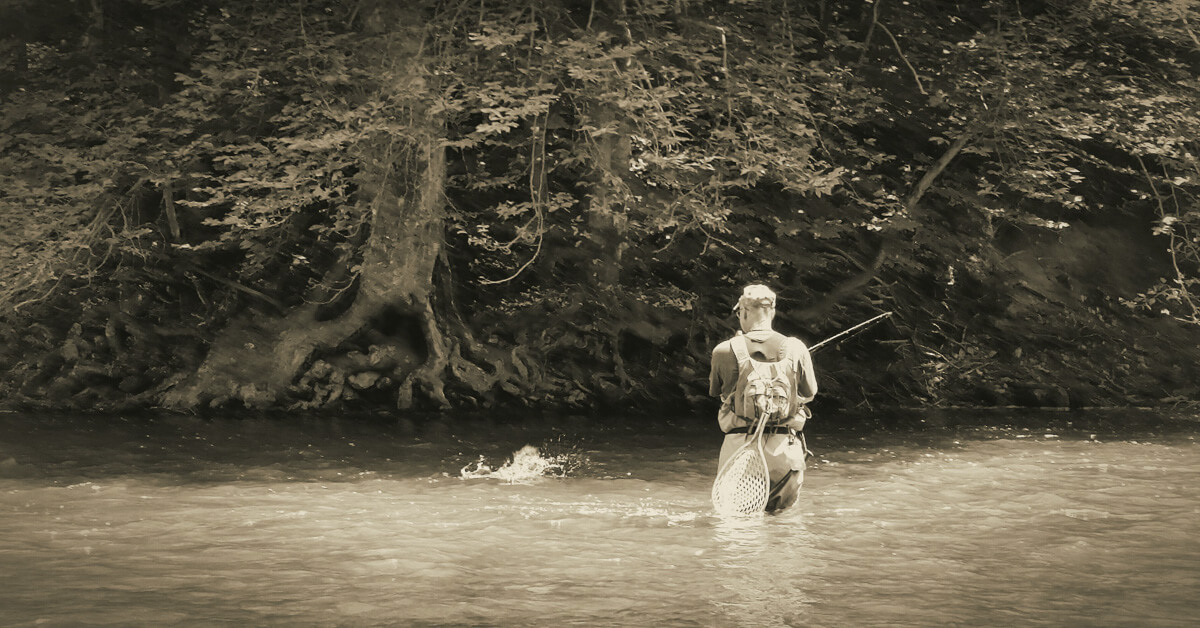
Stop me if you’ve heard this one before . . .
You gear up, lock the truck and hike down the ravine. Following the path of a shallow ditch, you enter the water where the spring-seep trickles in. And you cross the river where it’s wide and shallow. On the far side, you navigate over a maze of zig-zagging deer trails and around fallen timber for about a half mile. You climb the hillside to the railroad tracks and walk another quarter mile, scanning the river for the spot below — the one you and your fishing buddies refer to as Upper Honey.
In the off season like this, there are no leaves on the trees, and you can usually spot the ancient sycamore teetering bank-side, leaning over about thirty degrees, patiently waiting, month after month, year after year, for the day when it slips the bonds of its streamside earth and crashes into the water.
And oh my, those roots. Underneath the massive sycamore sits an exposed tangle of underground limbs — wet, flexible pipes as thick as your leg, with a shadowy cover where no sunlight penetrates.
How far back do those roots go? And how many monster brown trout live in the black water swirling through? It’s a wonderful mystery — the kind of unanswerable question that motivates you to walk these distances, to hike in hot waders anytime you earn enough free hours away from the rest of your life.
Upper Honey is down there somewhere below these tracks. And you know you’re getting close.

Photo by Ben Bishop
Walking fast now, and peering down from the iron rails, you start to think that maybe you’ve passed it up. You slow down. Then you finally stop, lift your sunglasses and wipe sweat from your eyes — too many clothes for such a long walk. Hands go to your hips, exasperated. Did you walk too far again? Did you pass it? Is it before the bend in the tracks or after?
Just as you turn around to retrace your steps, you see it. There’s the giant sycamore — towering over the head of a heavy run, right where it’s supposed to be. The sheltered inside bend is the only shadow on the river here at midday. And the branches provide an awning of wood, made of limbs wide and numerous enough to lay a continuous blanket of shade over the water, even without leaves or buds on the dying tree.
A hundred yards downriver and a fifty-foot drop above sea level from the railroad bed, the last stretch is mired in dense brush, with thorns that surely add to the leaks in your waders. But who cares?
And when you break free and leave the thick mess of resistance behind . . . there are the roots.
You wade slowly across the river and start to wonder just how this perfection was created. Was the riverbed already in this shape and the tree grew with it, or did the massive structure stand boldly against the face of flood waters — “You shall not pass!” — and force the river to go around? Did the giant tree itself create this place?
These are the questions you whisper as you reach toward the hook-keeper above the cork on your rod handle. You remove the back hook of an articulated sculpin, and you drop the olive pattern of rabbit fur into the cold water at your feet. You let that fly soak for a moment as you gaze up to the wide canopy of white and tan sycamore bark blocking the sun. You slowly follow the limbs down to where they meet the split trunk, then further downward to the soft ground and finally the dark roots. Oh my, those roots.
And you cast with all the confidence in the world.
Fish hard, friends.
** Donate ** If you enjoy this article, please consider a donation. Your support is what keeps this Troutbitten project funded. Scroll below to find the Donate Button. And thank you.
Enjoy the day.
Domenick Swentosky
T R O U T B I T T E N
domenick@troutbitten.com


Ok.ok. then you notice someone is fishing there. Oh no. All that wonderful water gone. What do you do.. wait. Try to fish below as you wait for the person to leave but they never do. Watching as they spin fish the hell out of the damn place and catch a monster brown. Maybe if you got there earlier next time. Sorry to ruin this great story. But that’s what usually happens in my neck of the woods.
That’s sad, Vince.
Great visuals Dom. It is the allure of places like that keep the flame if hope burning in anglers.
That!!!was a great article, Story, it perfectly sums up why we are obsessed with our passion of Fly fishing…. Thank you.
I am still feeling lost in those tangled underwater roots that bind us all in this wonderful world called home. Thanks for your poetry about these wild places!
“…awning of branches…” Nice!
In my neck of the woods it is “The Medusa Tree” which guards the hole of 20 inch trout. Her branches cradle a graveyard of flies and fishermen’s hopes.
Sycamores are arboreal entities of great mythical and mystical pedigree. This one is no exception.
I really enjoy the sense of anticipation you’ve managed to impart here. It’s much the same for all of us, I would imagine; your curiosity and adrenaline working together. A comment in one of the later paragraphs about using an articulated sculpin sent me back to the video on the Full Pint streamer construction. I see what you mean about sitting through entire album sides just to concoct a couple of them. They’re beautiful just the way they are, Dom, no flash needed…
We have all been to that very place. The place where we know the T REX of trout lives. I have fooled him a number of times but have yet to drag him out of the tangle. Why do I always go back? All of us know why. Maybe this year is the year he gets his picture taken.
Do it.