Fifty Fly Fishing Tips: #21 — Fear No Snag

by | Dec 17, 2017 | 3 comments

If you always play it safe, are you really playing the game?

As anglers, we walk up and down the river delivering one cast after another, all the while calculating the risks of each delivery. Or we float downriver in a drift boat, launching our flies near streamside brush, measuring our luck and skill against the chances of hooking soft branches and busting off another well-tied fly.

Playing it safe saves flies. It even saves time. But it catches fewer trout. And whether drifting nymphs across a rock garden, punching hairwing dries into hazardous hidey-holes or slinging streamers into bankside slots, it pays to take risks because the rewards follow.

Bottom

When fishing nymphs, I understand that if I want to fool some trout, my flies must be close to the bottom. So instead of dismissing slow action as the fish just being unresponsive, I like to take time to reassess. Am I really getting the flies down to the trout? Am I risking enough, or am I just trying to avoiding hanging up on the rocks?

READ: Troutbitten | Forget the Bottom — Glide Nymphs Through the Strike Zone

I’ve learned that changing flies is rarely the best solution. More often, it’s about getting my nymphs into the right places, down into the slots and pockets and closer to the bottom. When I nymph the right way, I get snagged on the bottom sometimes, but I just accept it as part of the game. Invariably, my best nymphing days are the same outings in which I sacrifice some flies to the river.

The same rules apply to streamers too. If the fish are hugging the bottom, if they won’t move up for the fly, then I have to go down to get them.

And if I’m more worried about the inconvenient bottom-snag than about getting my flies deep and right in the trout’s face, then I’m doing it all wrong.

Dando, fighting the cold

Top

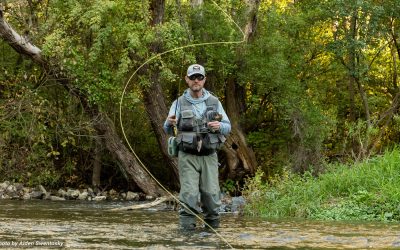
Fishing the surface requires the same boldness, the same intrepid attitude, if you really want to play the game. Without a willingness to put a few flies in the trees, you’ll pass up a lot of fish.

Approach the tricky lies and corner pockets with resolve. Tuck the flies in there with some precision, feed a little slack at the end of the cast, and hold on tight. If you hit a tree limb instead of the target, so what. Break the fly off if you must, or go get it back and try the next spot.

Fish with some audacity out there, and your confidence will grow.

READ: Troubitten | Hang Up or Hook Up

If you haven’t lost a few flies at the end of the day, then you’re doing it wrong. Taking chances is the only way. Fear no snag.

Fish hard, friends.

** NOTE ***  After reading this article, my friend, Chris, pointed out the importance of retrieving our broken-off flies and tippet whenever possible. And that’s a great point. I think we should fish boldly, but we should be just as bold about retrieving the flies and tippet wherever we can. Leave no trace.

This is the Fear No Snag Emblem Sticker. You can find it in the Troutbitten Shop HERE.

The Troutbitten Tree design is also featured on tees and hoodies. Find all the Troutbitten Tree stuff HERE.


Enjoy the day.
Domenick Swentosky
T R O U T B I T T E N
domenick@troutbitten.com


Share This Article . . .

Since 2014 and 1500+ articles deep
Troutbitten is a free resource for all anglers.
Your support is greatly appreciated.

– Explore These Post Tags –

Domenick Swentosky

Central Pennsylvania

Hi. I’m a father of two young boys, a husband, author, fly fishing guide and a musician. I fish for wild brown trout in the cool limestone waters of Central Pennsylvania year round. This is my home, and I love it. Friends. Family. And the river.

More from this Category

VIDEO: Waders On, Waders Off — Stop Wasting Fishing Time

VIDEO: Waders On, Waders Off — Stop Wasting Fishing Time

Most anglers hate wasting their fishing time. So, what we do at the vehicle at the beginning and the end of the day matters. Waders on — waders off.

Having a routine and a system that works efficiently saves time. Likewise, boot storage and rod/reel prep goes a long way toward minimizing wasted time and getting us closer to the next cast.

Fish and Film – Skinny Water Nymphing (VIDEO)

Fish and Film – Skinny Water Nymphing (VIDEO)

Fishing is a story . . . During some of the lowest water I’ve seen in our area, I chose to nymph the skinny stuff on a tight line. But instead of fishing fine and far off, I started with a drop shot of medium weight. Later, I mixed in a tracking approach with a single, light nymph. A couple hours in, I streamer fished a long flat, to test the trout’s response. And I finished the morning with some nice trout that responded to nymphs in the strike zone . . .

VIDEO/AUDIO: Riverside — Fighting Big Fish — Keep ‘Em Down

VIDEO/AUDIO: Riverside — Fighting Big Fish — Keep ‘Em Down

A top-tier river trout is a beast. The inherent nature of a river, with the endless obstacles, rocks, tree parts, current breaks, high gradient runs and undercut banks challenges the angler at every bend. So when you finally hook up with a Whiskey, a new game begins. It’s a match up between trout and fisherman. Who will win that fight?

Bringing a trout to the net requires a series of accurate calculations, thoughtful moves and a good dose of luck. But with a few guiding principles and a bit of experience, you can minimize the luck required and get a good handle on the outcome. One of the best of those principles, is to keep ’em down . . .

VIDEO: Crossover Style – Streamer X Nymph

VIDEO: Crossover Style – Streamer X Nymph

Crossover Technique is streamers on a tight line. It’s part streamer concept and part nymphing. There’s always a streamer on the point, and sometimes a nymph is added as a second fly.

The Crossover is all about taking a streamer to the fish. Instead of stripping our fly away from the trout, asking it to get up and chase, the Crossover style makes it easier for a lazy trout to say yes to the presentation.

Crossover techniques are subtle but attractive. We’re trying to inspire the trout to eat a bigger food form, while having precise control over exactly where the fly is and how it moves, all because we’re fishing it on a tight line, Mono Rig system.

Fish and Film – Home Base (VIDEO)

Fish and Film – Home Base (VIDEO)

Fishing is a story . . . I’ve fished all of my favorite rivers from their mouths to their headwaters. And within those mile of opportunity, my favored spots keep calling me back. I fish these places for a hard reset, for a return to home base — for getting back to the familiar by seeing what has changed.

What do you think?

Be part of the Troutbitten community of ideas.
Be helpful. And be nice.

3 Comments

  1. A man could make a small fortune re-claiming flies,indies and shots and he can also get very,very wet.

    Reply
  2. This spring I rescued a duckling along Quittaphilla that had tried to eat a hares ear left on bank brush close to the water level. I had never seen that before. She swam to safety but was traumatized nonetheless. Good advice

    Reply
  3. Unfortunately I’ve retrieved very few,if any tippet and flys,but miles of mono and lures. Do spinning fisherman get snagged,let out 50yds of line then cut off at reel? Used to spin all the time,knot should always break first!! Great article,it’s so true,have seen results when changing flys,but always greater results finding fish!!

    Reply

Submit a Comment

Your email address will not be published. Required fields are marked *

Recent Articles

Recent Posts

Domenick Swentosky

Central Pennsylvania

Hi. I’m a father of two young boys, a husband, author, fly fishing guide and a musician. I fish for wild brown trout in the cool limestone waters of Central Pennsylvania year round. This is my home, and I love it. Friends. Family. And the river.

Pin It on Pinterest